


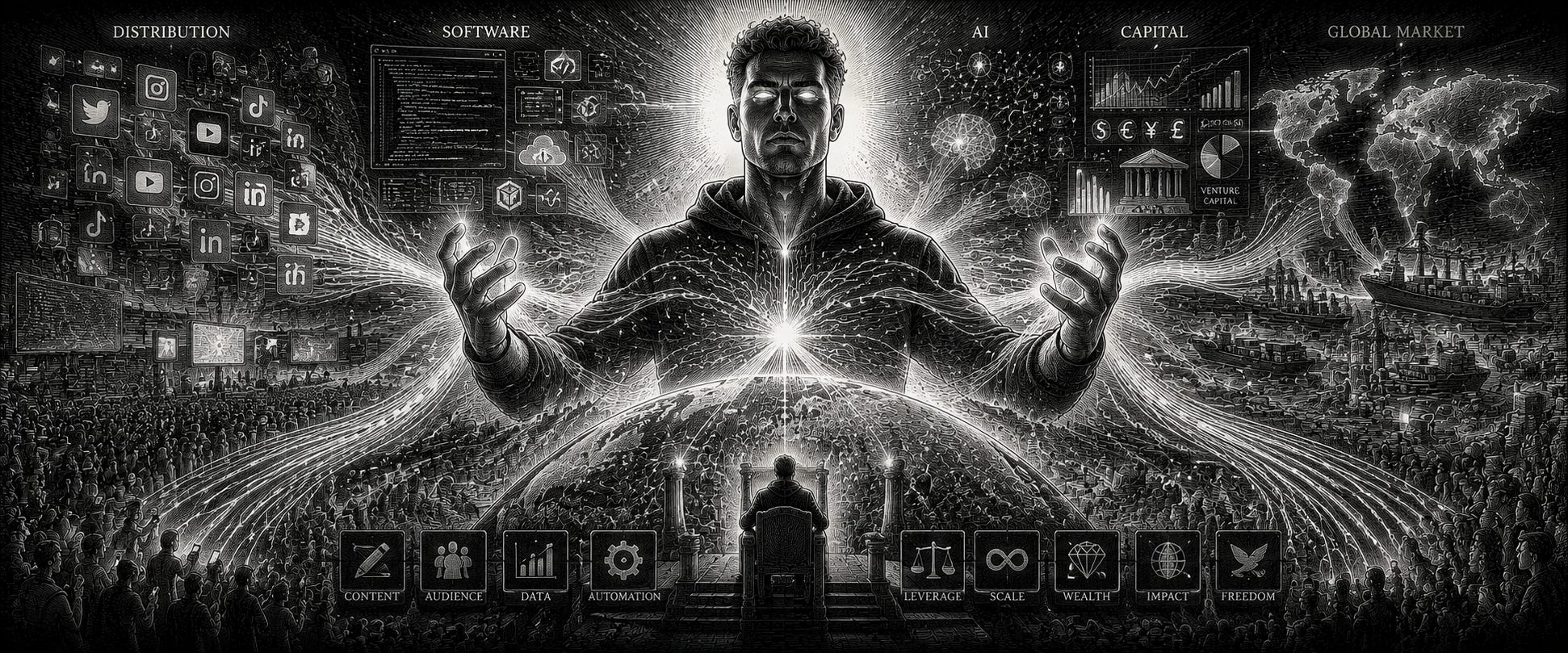
There has probably never been a better time in history than this moment right now, to be an ambitious individual with a laptop and an internet connection.
Sounds like the exact hook you’d see on an Instagram reel from a 20 something year old standing in front of his Lambo about to tell you about the new groundbreaking way anyone can become rich trading crypto or forex, I know.
But there’s more to this thesis.
Because the fact it, whether you like it or not, that a single person can now, with no prior experience, knowledge or skills, reach millions of people across our beautiful spinning globe. And even more interestingly, that same person can build software without knowing how to code, or even string together a small portfolio of digital products to sell ten thousand times over and over.
We live in this brave new world where you can just do things.
Hire expertise from almost anywhere in the world, raise money from people you have never even met in person, and increasingly day by day, delegate all your intellectual and administrative work to machines that cost less than a McDonalds happy meal.
I put that McDonalds happy meal in there very intentionally, because it’s an absolutely absurd thing to reference when we’re talking AI and internet leverage.
But I believe it’s a pretty suitable metaphor to highlight how the amount of leverage available to one person in this day and age, has become equally, if not more, absurd.
The past 4 years, I’ve first hand experienced a small version of that absurdity.
Starting from nothing, fed up with my 9-5 job, I’ve gone on to make over $1M in profit and built an audience of over 370,000+ people across social media, entirely from a laptop and WiFi connection.
And even more astonishingly, I’ve done so without building a traditional company around myself, without raising a single dollar and without hiring employees or sales teams, or even by spending any money on paid ads.
A large part of what made all this possible simply did not exist for someone like me less than a single generation ago. And that fact interests me far more than the million dollars I made along the way.
Because I think we are still very early in understanding what happens when ordinary individuals suddenly gain access to capabilities that used to require institutions.
That is what my newsletter, Internet Leverage, is about.
Before we dive in, let me share a little background with you.
A million f*cking dollars, dude.
Four years ago, I was stuck in a 9-5 job that I absolutely despised, spending most of my waking hours trying to crack the secret to how regular people seemingly made money on the internet left and right.
Today, I think it’s safe to say that… I did crack it.
I’ve made more than $1M in personal profit, built an audience of more than 370k people across different social platforms, launched 50+ products, sold information, advised million and billion dollar companies, and somehow done most of all that from my lil’ Macbook pro from hotel rooms and Airbnb’s around the world, still with no employees or organization behind me.
This feels as ridiculous to write out as it I believe it comes across reading it.
And I understand that the obvious go-to interpretation probably is that I simply found a good business model, or even worse… that I got “LuCkY”.
But I think there’s something much bigger at play here, and today we’re going to be walking through exactly what that is together, so hopefully, just like I did, you too can acquire an edge and use it to make a f*ck ton of that sweet internet cash.
Now, I believe it’s worth noting that I did start building my online business at a a critical moment, just when the internet was just starting to give individuals access to things that used to belong almost exclusively to companies:
Distribution and attention without a huge media company in the back
Customers across the world with no need for physical stores or inventory
Software and apps being built without huge companies or organizations
And with AI, access to an insane amount of intelligence and now also labor.
But that’s a good thing.
Because that era is just getting started. Heck, my older brother who was born in the early 80’s lived through the .com Boom and had every chance to make a gazillion dollars, but he didn’t. Instead, he became an engineer (and a well paid one at that).
Unfortunately for him, the world is changing once again, and now his job is at stake.
You and I are living through a different, yet similar shift, and one that’s just beginning.
And that is exactly what I want to dive deeper into.
So allow me to officially welcome you to…
Internet Leverage
Internet Leverage is my weekly newsletter exploring the new rules of work, money and life, and what becomes possible when one person suddenly has access to distribution, software, AI, capital and a global market.
I write about one-person businesses, attention as an asset, AI as leverage, internet-native wealth, ambition, culture and philosophy. More broadly, I’m interested in what happens as technology rewires how we work, think and live, and how you and I can use those shifts to get ahead in this brave new world.
Some essays are practical field guides with lots of juicy stuff that you can just apply.
Others are me following an idea until I understand it better.
But for you, it’s your edge.
A little corner of the internet where you get to tune in a few times a week to learn the new rules while everyone else is still playing by the old ones.
That way, you can spot the opportunities earlier, so you can make better bets, and as a result, compound that advantage across your work, money and life.
I spent 3 years trying to make money online before anything worked
My first attempts at entrepreneurship were pretty terrible.
At one point I burned around $9,000 trying to dropship women’s clothes. I also ran an Instagram account called The $1M Project, where I documented my grand plan to make a million dollars online.
I made plenty of content.
The million dollars took… let’s just say, a little longer.
For years, I bounced between ideas and business models. I was ambitious enough to keep trying and inexperienced enough to repeatedly convince myself that whatever I had discovered that week was finally going to change everything.
And most of it went nowhere.
That’s until I found Notion.
I noticed people selling templates for it, started a faceless Twitter account, and began posting while trying to figure out what people actually wanted.
My first tweets barely got seen. My first products were simple. My first sale was five bucks. But for the first time, something started compounding for me.
The audience grew a little, which helped the products sell better. The products gave me something useful to talk about, which helped then helped the audience grow even further. It was like a flywheel effect. As a result, new customers joined my email list.
Then that email list made my future launches even easier. And eventually better launches gave me more money to reinvest into whatever I wanted to try next.
About six months after starting out, I reached my first $2,000 month.
Then another.
Then another.
That’s when I quit my 9-5 job and just went all in on this internet money thing.
Over time, those Notion templates alone generated close to $300,000 in profit. I eventually expanded into information products, mentorships, high-ticket clients, partnerships, software, investing and various other things that looked interesting enough for me to spend far too much time on.
Eventually, the total personal profit crossed $1 million.
To this day, I’m still entirely solo.
And the coolest part is that somewhere along the way, I realized that the most valuable thing I had built wasn’t any individual product.
It was leverage.
The internet changed what one person can be
Only a few generations ago, your economic output, and as a result, your income, was hogtied to what you could physically do.
You had a set amount of hours. You lived in a particular place. You could reach the people around you in your community. But if you wanted to sell to a million people, you needed an organization capable of reaching a million people for you.
With the rise of the internet, those constraints shattered entirely.
A piece of writing on Substack today can reach ten people or ten million people for roughly the same amount of effort.
A digital product promoted on Instagram or Twitter can be sold repeatedly without being manufactured again.
Software that you don’t even build, but have AI whip up, can serve thousands of customers while you’re sleeping.
This also means that an audience becomes distribution you can repeatedly deploy.
I’d take it as far as saying that an audience online is the equivalent to a reputation 1000’s of years ago in medieval times. And if you build it right, it can create opportunities left and right for you.
Then the capital earned through one internet business can be moved into another business, an investment, software, property, or whatever comes next.
And AI is now accelerating this whole shebang.
One single person can write, research, code, design, analyze, automate, translate, edit and operate with capabilities that would have required a group of specialists surprisingly recently.
I find that much more interesting than any particular “make money online” tactic.
The real question is:
What becomes possible when one person suddenly has access to distribution, software, AI, capital and a global market?
I don’t think we know yet.
But I’m dedicating the next decade of my life to find out.
Primarily for myself, so I can leverage it to make more money, but also for you reading this, so you can model my steps, extract my insights, learn from my mistakes and hopefully gain some of that sweet Internet Leverage too.
The Rise of The TRUE One-Person Business
I already told you a handful of times that I run a solo business.
I keep repeating it for a very specific reason, because I’m specially interested in the rise of the TRUE one-person business which is actually 110% a one-person operation.
There’s been lots of talk about “solopreneurship” over the years, but nine out of ten times, those “solopreneurs” then have an EA, a VA and a couple freelancers, if not a photographer or videographer or creative director to help out.
I don’t blame them, because for most of history, business growth meant adding people by default. More customers always required more employees, more management, more layers, more infrastructure and more complexity.
The internet and especially AI has now created an entirely different path.
A single person can build the audience, sell the products, operate the software, use contractors on a project basis only when needed, automate large parts of the business, deploy AI to do most of the works, and then invest the profits elsewhere while remaining remarkably small.
I call my version of this a High-Profit One Person Empire™, or H.O.P.E™.
At the end of this article, I’m going to drop a link to the next natural step if you want to learn more about this model. It’s a full scale field guide to get started with it yourself.
For now though, I need you truly internalize what this actually is, because trust me, it’s not what it sounds like.
The important word in it, is not really “one-person.”
It’s empire.
What I’m really doing is building a collection of assets that all reinforce each other.
An audience (or a few of them actually, so far I have 5x different social accounts).
An email list (or a few actually, depending on where the traffic is coming from)
A portfolio of different products, whether templates, courses, guides or whatever.
Software products that AI builds for me, or that I take equity in with others
Investments, whether stocks, crypto, real-estate or whatever produces a profit
Reputation, which in this case, is an intangible asset, but one that leads to:
Relationships, which I’m just getting into, but turns out… they’re very profitable.
Each asset makes the next one easier to build.
My Twitter audience helped me sell Notion templates → The templates created cash flow → The cash flow let me take bigger bets → The email list I built off it, helped me launch other products → That experience created opportunities with companies, many which turned into clients → And those relationships opened other doors, which turned out to be even more valuable.
Over enough time, the individual projects I work on matter less than the machine connecting all of them.
This machine, my “empire”, is exactly the definition of Internet Leverage.
It’s equally that important you understand that I don’t want this newsletter to become a weekly tutorial on building Twitter audiences or selling Notion templates.
Because this idea is much greater than any of those things individually.
It doesn’t matter WHERE you start, or WHAT you start with. Heck, you could be a freelancer, an agency owner or a f*cking printable planner guru. It doesn’t matter.
If you follow this idea far enough, it will produce just as crazy results for you as it did for me, no matter where you start (and yes, even if you haven’t started yet as well).
Now, one other important thing.
Money eventually becomes a life question
When I first started, I wanted money because I didn’t have much of it.
That makes things fairly simple. You optimize for earning more. Longer hours. Neglecting everything, but money.
Then, if things go well, the questions change.
How much is enough?
How much complexity are you willing to introduce to make more?
Would you rather own 100% of a smaller company or 10% of a huge one?
How much of your life should ambition consume?
What is the value of living wherever you want?
When should you reinvest in the business and when should you move money into investments?
How much freedom are you willing to sacrifice for another zero?
What happens when the business you built to escape a job becomes another thing capable of owning all of your attention?
These questions are not questions I would’ve ever asked myself in the beginning, and to be honest, I didn’t ask them at all. At least not until now.
The thing about these questions is that they’re not just economic, but they are also highly philosophical. The same is true for health, relationships and family.
If your business gives you control over your time, how should you use that time?
If technology lets you work from anywhere, where should you actually live?
If AI makes you dramatically more productive, should you use that productivity to produce twice as much, work half as much, or attempt something that previously seemed impossible?
If you want children one day, how should that change the way you think about money, risk, location and ambition now?
I’m far more interested in those questions because with my HOPE, the business is naturally a big part of my life, and the further I go, the harder it becomes to cleanly separate the two.
And maybe the answer is that… we don’t need to.
Instead, we build a business that aligns with our life, so that work becomes play.
That’s for another day.
Everything the internet is doing to our brains
There is another side of Internet Leverage that has very little to do with making money directly. In fact, I’d argue it’s the very thing that’s keeping most people stuck from actually building any kind of leverage.
See, as a part of running my business, I spend an unhealthy amount of time online, which also means I spend an equally unhealthy amount of time thinking about what technology is doing to people.
We live inside systems engineered by scientists who could spend their time curing cancer, but who spend it designing apps that capture attention, predict behavior and compress culture into trends that give everyone this endless, almost evil, stream of novelty.
Our information diets have become algorithmic, our social lives increasingly pass through screens and our status games have become public and measurable.
People are building identities around metrics that did not exist twenty years ago.
Today, millions of us have access to more information than any king in history and somehow spend a large portion of that miracle watching fifteen-second videos of people arguing about things we will forget tomorrow.

Brainrot is funny until you realize it might actually describe one of the defining problems of modern life. And AI is about to make the environment much stranger.
I’m of the firm believe that within long, most people will interact constantly with synthetic text, synthetic images, synthetic video, synthetic personalities and software capable of knowing more about them than many of their friends do.
Work will change.
Education will change.
Relationships will probably change too.
And most importantly, the value of certain skills will collapse while others become far more valuable.
We’re going to reach a point in time when the amount of content in the world will approach infinity, which in return makes genuine attention, taste, trust and reputation far more valuable assets.
Nobody has a complete map for where this goes. We can only guess.
It’s equally connected to building leverage on the internet, because as the internet becomes so intertwined with the real world, those who understand how to position themselves early (just like the people who did YouTube before everyone else did it), will be the ones to reap the rewards.
That’s exactly why I want to explore this idea.
Internet Leverage is really about the new rules
The world I grew up in, where being prepared for everything was the MOAT, feels a little bit outdated as I’m writing this essay.
It used to go something like:
“Study something useful, get a well paying job at the end, then climb the ladder up some corporation, use the money to buy a house and start a family, and then keep going until you can retire eventually”.
That path was never for me. Something about working 5 days a week for 2 days off, or working for 60 years to get maybe 5 or 10 years of retirement before you die, never quite sat right with me.
I concede that the path still works for and satisfies plenty of people, but the truth is that it is no longer the only available option like it was a few decades ago.
A 14 year old can start posting stupid TikTok videos and build an audience larger than the audience of a billion dollar corporation. Even more ironically, he can then go to that very same billion dollar corporation and teach them what he did, getting paid in a single month what his parents would get paid in a decade.
This is absolutely absurd, I agree. But hate or love it, it’s the world we live in now.
And now AI is lowering the amount of technical skill and labor required even further.
The rules are moving quickly.
And as with any time in history, whenever rules change, there is a period where people who understand the new environment early have an outsized advantage.
That is the edge I’m interested in.
I want to understand the shifts while they are happening, work out which ones actually matter, and figure out how an individual can use them intelligently.
Sometimes the answer will be very practical.
Sometimes the answer will send me into a philosophy rant.
Both belong here in this newsletter.
What I’ll actually write about
Every week, I’ll publish an essay or two around something I’m thinking about deeply enough that I need to write my way through it.
One-person businesses will be a recurring theme because I think we are entering an extraordinary period for tiny companies with enormous leverage. I’ll write about audience, distribution, attention as an asset, products, pricing, software, investing and the mechanics of building a business around yourself without turning yourself into an exhausted employee of your own creation.
AI will obviously show up a lot.
I’m interested in AI as leverage for individuals, but also what happens when intelligence becomes abundant. What happens to jobs, education, creativity, status, entrepreneurship and the value of human work when everyone has access to increasingly capable machines?
I’ll write about money and what I’ve started calling internet-native wealth, where value begins as attention, skills, code, reputation or distribution and eventually gets converted into businesses, equity, investments and assets outside the platforms where it started.
There will be essays about ambition, because I have spent most of my life being unusually ambitious and still don’t entirely understand whether that is a superpower, an illness, or some combination of the two. To be decided.
There will be also be ideas and thoughts on culture, philosophy, technology, brainrot and society because these things shape the environment every business and every person now operates within.
And, occasionally I will follow an idea purely because I cannot stop thinking about it.
Those might end up being some of the best essays.
There is another version of me on the internet
You may know me from my faceless cartoon character profile Pascio.
If not, a short introduction, because the distinction between these two accounts will become more obvious from here.
Pascio is where I build stuff.
I just kicked off my newsletter there called Side Quests, which is basically my weekly field log from the trenches. That is where you’ll see the prototypes, launches, acquisitions, experiments, weird ideas, numbers, failures, growth plays and whatever rabbit hole I’m currently chasing.
I might decide to build an Apple Watch app one week and try to acquire an old internet business the next.
Pascio gets the messy process.
CreatorPascal is my personal brand.
And Internet Leverage, this newsletter, is where I zoom out.
If a Side Quest teaches me something interesting about why AI makes one-person companies possible, that larger idea belongs here.
If I run a growth experiment and realize something about the economics of attention, I might turn that into an Internet Leverage essay.
If building a business changes how I think about ambition, money, health or the way I want to spend my life, that belongs here too.
Pascio asks, what happens if I try this?
Pascal asks, what does this tell us about the world we’re entering and how can we use what I just learned to make a f*ck ton of money (while staying solo operators the entire way)?
I like having both because that is roughly how my brain works anyway.
I build things and then overthink what they mean.
Why write any of this?
There was a period where I mostly treated content as distribution.
You publish because publishing grows the audience. The audience grows because you publish. Eventually you have something you can sell to that audience.
That loop obviously still matters to me.
But long-form writing has started serving a different purpose.
Writing forces me to decide what I actually believe.
You can hide a surprisingly large amount of fuzzy thinking inside a tweet. It is much harder to survive 2,000 words without discovering that part of your argument makes absolutely no sense.
So some essays here will be me teaching something I know.
Others will be me trying to understand something I don’t.
That distinction is super important for you to understand, but even more so for myself, because I’ve decided I don’t want to spend the next decade pretending I have already solved every question worth asking and then charging you a premium for the answers.
I would rather have a place where I can follow ideas while they are still developing, change my mind when the evidence changes, and hopefully leave behind a useful record of how I thought through a period that I suspect will look historically insane in hindsight.
Call it my Digital Heritage (that’s a whole other idea I’m thinking about, the essay on that is going to absolutely mindbendingly in-fucking-sane).
Anyway, enough rambling.
The internet already changed how I work and make money.
Now AI is beginning to change how I build things.
I expect both to change far more than what it is today.
And I’ll take you with me on the journey as I dive deeper into how far that is.
What’s in it for you?
My hope is that Internet Leverage becomes useful in two ways.
The practical essays should give you things you can actually apply. Ways to build distribution, structure a one-person business, create products, use AI, think about attention, make better decisions with money, or recognize opportunities that are hiding in plain sight.
The broader essays I write are intended to help you build a better model of what is happening around you right now.
Because having the right mental model matters as much as the business model.
If you understand a shift before it becomes obvious, you get more time to act on it.
That way, you can build the skill before everyone wants it, enter the market before it gets crowded and start accumulating the asset before everyone agrees it is valuable.
That is the real promise of Internet Leverage.
For you, this is your edge.
A way to learn the new rules while everyone else is still playing by the old ones, spot opportunities earlier, make better bets, and compound the advantage across your work, money and life.
I have no idea exactly where the next ten years take us.
I’m pretty convinced they are going to be weird as fuck.
But I’m here for wild ride. I hope you are too.
Welcome to Internet Leverage.
- Pascal
Thanks for reading Internet Leverage!
Internet Leverage is my weekly newsletter exploring the new rules of work, money and life, and what becomes possible when one person suddenly has access to distribution, software, AI, capital and a global market.
I write about one-person businesses, attention as an asset, AI as leverage, internet-native wealth, ambition, culture and philosophy. More broadly, I’m interested in what happens as technology rewires how we work, think and live, and how you can use those shifts to get ahead.
Some essays are practical field guides.
Others are me following an idea until I understand it better.
For you, it’s an edge.
A way to learn the new rules while everyone else is still playing by the old ones, spot opportunities earlier, make better bets, and compound the advantage across your work, money and life.
Subscribe below for free to join 33,000+ subscribers receiving weekly posts.
(or click here to read a few editions first)
Things I am working on outside this, in case any of them are interesting:
If you want to build a High Profit One-Person Empire™, read this free article.
If you want to grow on Twitter, check out Stanley, my AI Head Of Content.
If you want to see what I’m building, check out my newsletter Side Quests here.
Love this Pascal.