


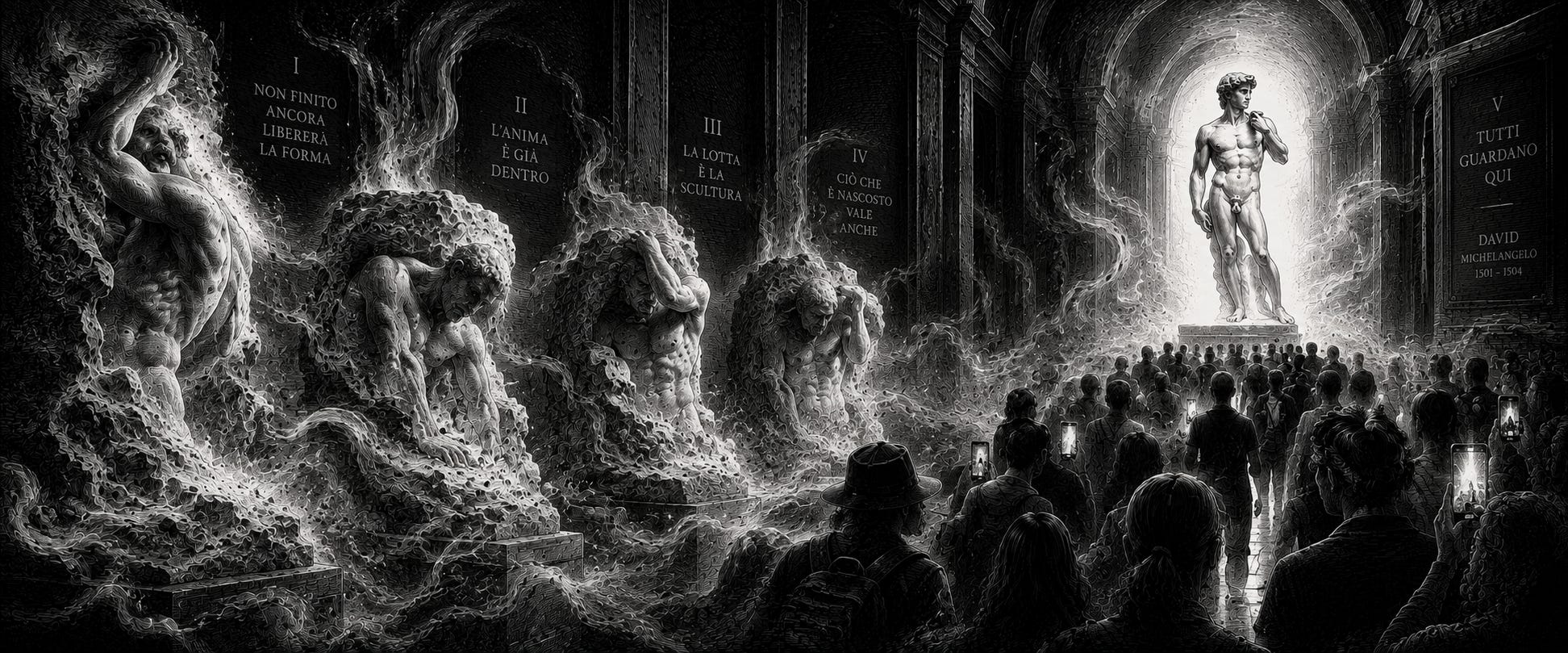
Take a walk into the world famous Galleria dell’Accademia in Florence right now and you’ll see everyone looking past the four men who appear to be drowning in stone.
They’re all focused on David, the main attraction at the end.
Leading up to it are Michelangelo’s Prisoners, which line the corridor on the way there.
I find this piece particularly unsettling.
One figure twists his shoulder free while the rest of his body remains trapped inside a block, and another has the beginning of a face, a chest, and the suggestion of legs, though large sections still look almost like raw quarry. The chisel marks remain visible even five centuries later, which means you can literally see the sculpture and the material it came from at the very same time.
The most interesting part is that the piece was left unfinished.
A finished statue lets you forget what had to disappear to create it. The Prisoners leave the process exposed. Every muscle required marble to be removed, and every cut made thousands of other possible figures impossible.
Now… why am I yapping about an art piece?
Because I’ve spent YEARS doing the business equivalent.
For most of the time I’ve been running my business, my model was basically adding more. More templates, products, audiences, newsletters, courses, services, software, partnerships… and way too many domains for business ideas that never became a thing.
Yet, much of it worked.
If you’re just starting out, quantity is still the medicine I’d prescribe if I was your business doctor. Early on, one addition opens the door to the next, and over time that collection gradually becomes a business. That model is what I call The High Profit One Person Empire™, which I wrote a whole article on here.
But I’ve also realized that the same approach that helped me build everything starting from scratch… can only take me so far.
Accumulation, quantity and speed are excellent for going from 0 to 1, yes.
But going from 1 to 10, or 10 to 100, eventually requires something else:
Subtraction
After realizing this, I also realized I had to do something painful:
Shut down my most successful product, Notion Money Academy.
More than 500 students have gone through this program. Some went on to make four and five figures, a few reached six figures, and most went from zero to earning their first money online, ever.
From a business POV, it has indeed been a very successful product.
It generated more than $250,000 in profit. I still believe in the lessons inside it, I would still recommend many of them to beginners today, and the product could very well continue making money if I kept it alive.
Its success is exactly what makes the decision interesting.
Why would I retire a product that still works and still makes money?
That’s what I’ll break down today, and hopefully it makes you think differently about your business, and maybe even your life, through the lens of subtraction.
Because there’s one question no one ever asks (so I will).
What happens when your life fills up with things that actually worked?
We are trained to accumulate
For most of human history, accumulation was a sensible response to life.
Grain in storage carried a family through winter. More land produced more food. A larger herd meant security. Tools, property, ships, factories, and capital expanded what a person could do and protected them when conditions turned against them.
Our language still carries that history today.
We build wealth, grow companies, expand portfolios, increase output, gain followers, add features, and acquire assets. Progress appears as a rising line because growth is easy to count. A larger number offers visible proof that yesterday’s effort produced something.
The industrial economy then continued to strengthened this human instinct.
A serious company needed offices, machinery, stock, employees, and distribution. Scale always left physical evidence. The bigger enterprises occupied more land, employed more people, and produced more units.
Even decline had a visible form.
Warehouses emptied, factories closed, and unsold inventory began costing money.
Then, digital businesses came around and changed the physics of accumulation.
A course takes up no warehouse space, an old newsletter can sit dormant for years, a domain renews quietly in the background and a piece of software may keep collecting subscriptions while receiving very little attention.
The internet allows one person to own a strange collection of businesses that would once have required several buildings and a few hundred employees to run.
This is one of the great promises of internet leverage.
It’s so exciting that it keeps me up at night jotting down 3,000 word long essays like this one. I find it particular interesting that anyone can create an asset once and let it work far beyond the original hour, whether that’s a product, a piece of content or a Substack article like this.
But the more I think about it, the more I realize that the same economics create another problem.
Digital assets barely occupy physical space. Good. But they also rarely force a decision. They can remain open, available, and almost maintained. A course still exists, a community still has members, and an old product still gets a few sales.
Nothing breaks badly enough to demand an ending.
So in that process, the founder becomes the warehouse.
Every product sits somewhere in memory with its customers, promises, pages, positioning, examples, and unfinished improvements. Some projects occupy very little time on a calendar while taking up permanent space in the mind. They return during walks where you’re not supposed to think about work. A casual mention here and there, and guilt creeps up on you. Or when a competitor relaunches something similar, an hour can disappear into wondering whether yours should return.
A physical room eventually becomes full. There’s no way around it. Space is space. But… a digital business can keep accumulating long after the person running it has run out of attention.
The internet’s cabinet of curiosities
During the Renaissance, wealthy collectors assembled Wunderkammern, cabinets of curiosities filled with shells, fossils, mechanical clocks, preserved animals, religious relics, art, and objects brought back from distant parts of the world.
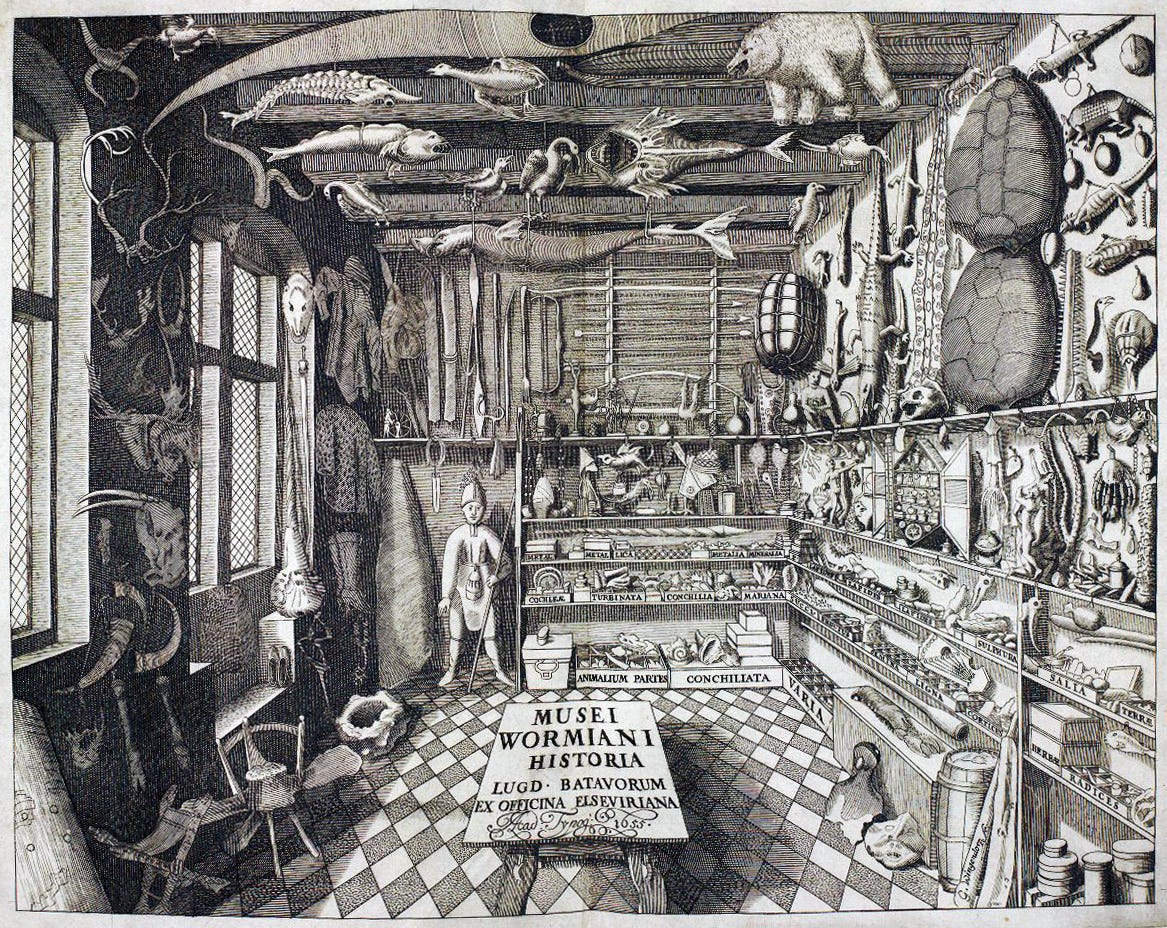
The collection demonstrated wealth and learning, but it also reflected a more ambitious desire:
Its owner wanted to hold a miniature version of the world inside one room.
Ironically, we’ve backtracked a few centuries, because a lot of modern internet businesses resemble those exact cabinets. Open a founder’s laptop and you may find a course, an agency, a newsletter, a community, a small software product, three inactive social accounts, a podcast with twelve episodes, a paid group that still has thirty-seven members, and a folder containing the next big idea.
Every object has it’s own story. Several of them probably made money and even a few could probably work again with enough attention and effort put into it.
So the collection feels valuable because it represents optionality. It produces the feeling that any piece might become important later. The old audience could support a new launch if leveraged right, the abandoned software might find its viral moment if presented right, and the domain bought two years ago still has a suspicious amount of potential if only enough time is put into it.
But it’s a trap.
I know this now, because curiosity built much of my life. The Side Quests I took on gave me skills, distribution, relationships, and a better sense of what I care about.
And I’ll say it one more time for the people in the back: a person starting from zero should probably try more things than feels sensible, because reality teaches faster when it has something concrete to react to.
The problem shows up after the experiments become obligations.
An idea sitting in a notebook remains light. But the moment customers pay, a promise enters the picture and that revenue adds a new layer of responsibility.
Optionality has a point of reversal.
Early options create room to move. Good. But mature options demand maintenance, decisions, and emotional bandwidth. When you keep enough of them alive, you eventually lose the freedom they were supposed to create in the first place.
Borges, a famous Argentine essayist, imagined a garden in which every possible path keeps branching into another future. This is a particularly interesting take today, because the internet can make what was essentially fiction, feel practical. Every path is visible. You watch somebody else succeed on it, buy the domain, copy the business model into a document, and begin before lunch.
But the ability to see every possible life makes commitment feel strangely primitive.
Choosing one direction closes the others, and modern culture prefers to keep the menu open. So we end up collecting projects on projects, partly because each one protects us from the grief of deciding who we are going to become.
Or who we weren’t supposed to be in the first place.
Now, I know we’re going deep, but stick with me here.
Successful things develop gravity
Failure is one of the most important things to happen to you, because it gives you permission to move on: the market simply answers, the money runs dry, or your own boredom becomes impossible to ignore.
But a what happens when you don’t fail… but succeed?
This is one of the scarier paths, because successful project keeps making a case for itself. It continues to produce evidence: people bought it, customers liked it, the margins are good, you know how to sell it.
Closing it almost feels like… vandalism to your ego.
Notion Money Academy belongs to the period when I learned how to turn internet attention into a real business. It carries the story of how I sold Notion templates, built a ginormous audience, and discovered that a person with a laptop could create income without waiting for an employer, investor, or institution to approve the plan first.
That history is not only important to me, but it’s important to every student who joined and who wanted to do something similar with their life.
But this story is also the story of my future.
Because during the time I ran this program, I learned that a business model comes with a way of spending your life. A course asks you, the creator, for continued updates to a curriculum, ongoing launches, more student support than you’re comfortable with, calls, questions, and a continued 360 spin right back to the problem that the product is designed to solve.
A profitable asset does more than produce revenue.
It casts votes for the person you will continue becoming.
Whatever the project is, it gradually becomes the center of a small solar system, and future decisions begin orbiting around work chosen by an earlier version of you.
I’ve often seen other founders and creators describe this as focus, though the deeper issue if you ask me, is authorship.
Because who gets to decide what the next decade contains?
You do.
But the current you.
Not the past you who made a good decision five years ago. You’ve outgrown that person. And that person should not receive permanent control over the present.
More often than not, I see different versions of this, where successful businesses turn into museums of former selves. Every room in that museum displays something that worked. And the proud founder walks through it, giving tours, maintaining the lighting, and explaining why each exhibit mattered, while the work that actually makes him feel alive remains outside waiting for space.
Real requires disappearance
The idea that growth depends entirely on addition sounds good until you take a step back, study biology, and look at how living things acquire form.
Early in embryonic development, a hand begins more like a paddle than five separate fingers. The digits emerge because cells between them undergo programmed death. Biology removes living material with extraordinary precision, and that absence creates the shape we all recognize as a hand
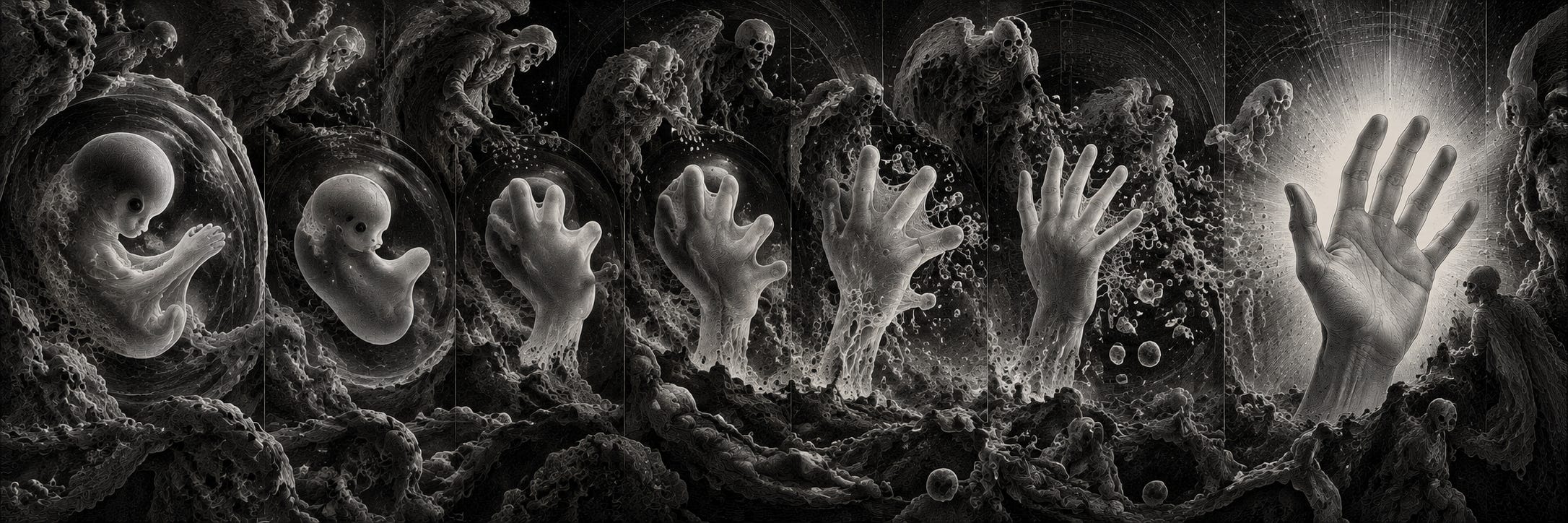
The process looks wasteful at first. Healthy cells appear, perform a temporary role, and disappear. But from the perspective of the whole organism, that removal is part of construction.
Business is very similar in it’s own unique way.
Projects can be useful during one stage and obstructive during the next. Take a service for example. It can teach you sales and human psychology. Or a course, which can show you how customers think. They provide the confidence needed for the next step. So in isolation, they’re a net positive.
Yet, each may finish its developmental role long before it stops producing money.
And just like with the embryo, keeping every stage alive creates a malformed whole.
The business that contains all of its history at once, has no distinction between scaffolding, structure, and the finished room.
Subtraction is what gives form to ambition.
Take a person who wants to write, build software, advise companies, acquire businesses, travel, spend time with family, stay healthy, and follow every interesting idea.
Looking in from the outside, he has a collection of worthy desires. Yet that person will only thrive when those desires are arranged, limited and given different seasons.
More than two thousand years ago, Chapter 11 of the Tao Te Ching used a wheel, a vessel, and a room to make this exact point (just so you know I’m not pulling this out of my ass).
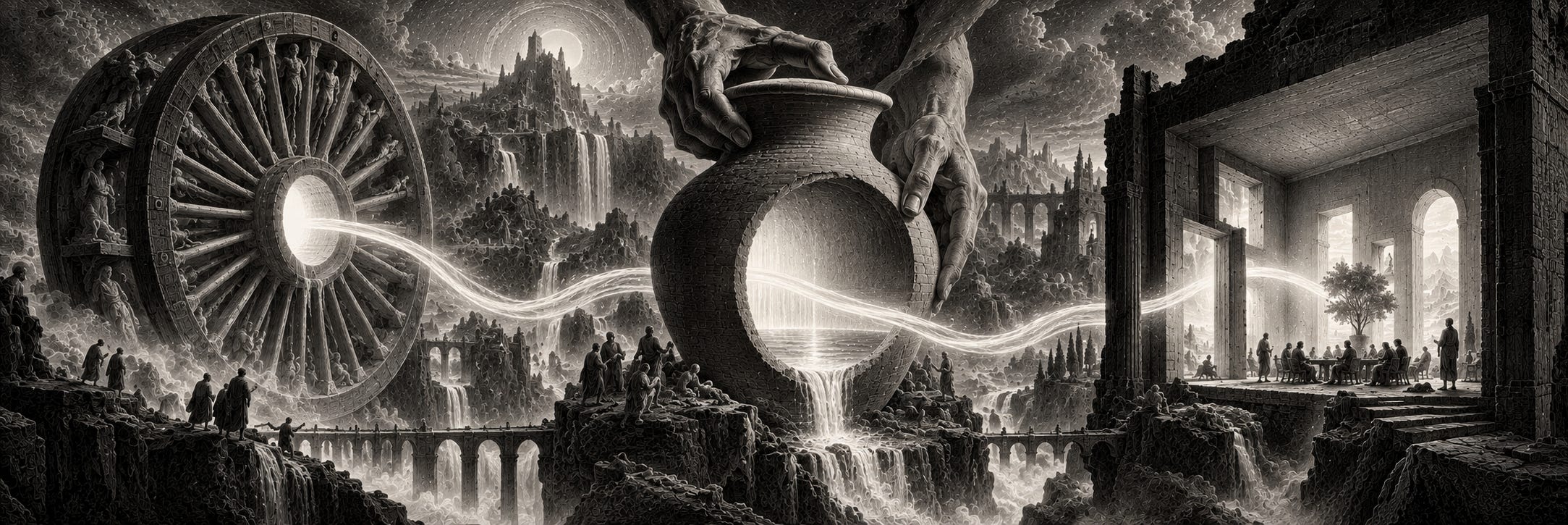
Spokes give a wheel structure, though the empty hub lets the axle turn. Clay gives a vessel its walls, though the hollow holds the water. Walls, doors, and windows define a room, though people live in the space they leave open.
In modern business, we count products, followers, subscribers, employees, features, calls, and hours. But yet, the empty hub will never show up on a dashboard.
It appears as the afternoon available to follow an unexpected idea, the spare capacity to respond when the world changes, or the mental quiet needed to realize that a once-good direction has gone stale.
A business with no open space becomes fragile.
Every hour is always promised away, every project has a constituency, and every channel expects more content and more output.
Yes, while the operation may look efficient from the outside, it’s typically only until something truly important appears. Then a new possibility has nowhere to enter from.
Subtraction is the fix to that. It’s what gives the business coherence. Because after it, everything that remains, contribute to the recognizable whole.
Michelangelo’s Prisoners is such a pristine example of this, hence why I chose to include it as an example in this essay, because the coherent form is only partly visible while the surrounding marble records all of the remaining work still required.
I sometimes look at my own business in the same way.
There is a clearer shape inside it, though large pieces of old ambition remain attached.
Yes, a decision is a cut
The word decision comes through Latin from decidere, literally “to cut off.” The history of the word understands something I feel our “productivity culture” often avoids.
Choosing requires an ending.
And any decision separates one future from all the futures that remain possible a minute earlier. It’s actually quite scary if you think about it too much.
It also explains why planning almost always feels easier than strategy.
Planning allows every good idea to receive a place on the roadmap.
Strategy accepts that some good ideas will never happen, at least under your ownership and during this period of your life.
Steve Jobs faced a much larger version of this problem when he returned to Apple in 1997. The company had accumulated this confusing range of computers and projects.
So Jobs did what I today consider a subtraction masterclass. He reduced the product strategy to four boxes, consumer and professional, desktop and portable. That reduction cleared the ground for the iconic company Apple later became.
The story is usually told as evidence of Jobs’s “taste”. But I think it’s much more than taste. It shows the social cost of clarity, because every removed product had supporters, employees, sunk effort, and an argument for survival.
Focus sounds elegant after the results arrive.
During the cut, it feels like waste.
This is where founders get trapped, myself included. We want subtraction to come with proof that the removed thing has become worthless.
But if that proof is not there, what do you do?
The Subtraction Audit
The hardest part is identifying which successful things have finished their job.
Revenue offers an incomplete answer because a project can earn money while consuming the future you would rather build. Excitement also changes too quickly to serve as the only guide. So I have found four questions to be way more useful.
1. Would I rebuild this from my current position?
Imagine your project disappeared tonight while leaving your money, audience, skills, and reputation intact. You would keep everything it taught you, though the machinery itself would be gone.
Would you rebuild it?
A fast yes usually points toward renewed investment. Hesitation reveals a commitment that survives history, habit, or fear.
This question removes sunk effort from the room and asks whether the future value still earns the future cost.
2. What life does operating this well create?
Picture three years of running the project with the care it deserves. Look at the Monday mornings, the recurring conversations, the kind of problems waiting in your inbox, and the skills receiving most of your attention.
A business can look attractive as a financial object and feel wrong as a calendar.
3. What is the full maintenance cost?
Hours are the visible part here. But mental re-entry, guilt, fragmented attention, delayed decisions, and the need to preserve context make up the rest.
Some projects require several days each month and feel clean because they sit at the center of your work. Others need two hours and somehow follow you through the week.
The second project carries the higher cost.
Write down every active promise in the business, including products, clients, channels, partnerships, communities, and recurring content. Next to each one, record the time it uses and the thought it creates. The second number will never be precise, though naming it changes how you see the portfolio.
4. Where will the recovered attention go?
Subtraction needs a destination.
Nature hates an empty calendar almost as much as a founder does. Messages, small improvements, and fresh ideas expand into whatever space becomes available.
Closing one project creates room for something new, maybe a new idea, a body of writing, deeper work for fewer clients, a relationship, physical recovery, or several months with no commercial objective.
The destination should be clear enough to protect the space.
Some of that space can remain unclaimed. That’s fine. But empty hours give ideas time to become convictions before they become obligations.
I have started to treat that openness as an asset in its own right.
The courage to leave value behind
Entrepreneurs are almost always taught to extract the maximum value from every asset. Turn the audience into an offer, then the offer into a funnel, the funnel into recurring revenue, and that recurring revenue into something that can be sold.
The logic makes sense, I agree.
But follow it far enough and every interest you have eventually becomes an obligation to monetize its full potential.
I think human life runs on a different accounting system. The value of a project includes what it teaches, who it connects you with, the identity it helps you form, and the next chapter it makes possible. Some assets simply produce their greatest return by carrying you to a place where you can finally release them.
Notion Money Academy gave me proof that I could build a serious education business. It helped hundreds of people see that a small digital product could become the beginning of something much larger. It generated over $250,000 in profit and became part of the foundation beneath everything I built afterward.
That return does not disappear when the checkout page closes.
But keeping the academy open would also preserve only one stream of value, while closing it releases another. The second is harder to measure because it arrives as a future that has not produced the numbers Motion Money Academy has (yet).
Subtraction really requires faith.
If you just add things, you get an object immediately. You can point at the new product, customer, employee, or revenue line.
Subtraction gives you space.
And space looks empty until something worthy grows into it.
I have spent years becoming capable of building almost anything I find interesting.
That capacity once felt like complete freedom. I now understand that freedom also depends on leaving some interesting things unbuilt, allowing some profitable things to end, and accepting that a coherent life will always contain fewer possibilities than the imagination can produce.
At the Galleria dell’Accademia, the unfinished Prisoners remain on the path toward David. They show the block, the figure, and the distance between them. Part of their beauty (if you dare notice it), comes from seeing all three at once.
I am somewhere in that corridor with my own work.
The past is still visible in the material around me. Notion Money Academy belongs there, as evidence of what the earlier chapter made possible.
But it no longer needs to occupy the room I am trying to build next.
The work ahead begins with a chisel.
One chip at a time.
- Pascal
P.S.
I’m retiring Notion Money Academy for good on September 30th (in 3 days).
Until then, you can grab the entire thing, meaning the exact courses, resources, and workshops that have helped hundreds of people generate their first ever online income,
… for just $99.
It used to cost $497 to get access when I was actively running it, but because I’ve now turned it into a self-paced program for this final edition (with no support from me, and no access to a community), it’s naturally cheaper.
Grab it if you want.
Go build a great business with it.
And then, just like me, one day, you too shall pivot and subtract to be able to reach the higher levels of the game.
But just remember, you have to start somewhere first.
I recommend you start here.
Thanks for reading Internet Leverage!
Internet Leverage is my weekly newsletter exploring the new rules of work, money and life, and what becomes possible when one person suddenly has access to distribution, software, AI, capital and a global market.
I write about one-person businesses, attention as an asset, AI as leverage, internet-native wealth, ambition, culture and philosophy. More broadly, I’m interested in what happens as technology rewires how we work, think and live, and how you can use those shifts to get ahead.
Some essays are practical field guides.
Others are me following an idea until I understand it better.
For you, it’s an edge.
A way to learn the new rules while everyone else is still playing by the old ones, spot opportunities earlier, make better bets, and compound the advantage across your work, money and life.
Subscribe below for free to join 33,000+ subscribers receiving weekly posts.
The Prisoners are the right image. Subtraction was the hardest skill I learned as a founder, because every piece I cut had once been a good idea. One after another, the side projects I built to give my inner fire an outlet fell apart, were handed over to my partners, or were simply terminated. None of it felt like progress at the time. It looked like losing things.