


I think a lot of people secretly want to build something on the internet.
The idea of making money online sounds exciting, especially when it lives privately inside your head. Most have this picture perfect idea of finally quitting their job, selling something of their own, waking up to Stripe notifications and working from wherever they want without a boss breathing down their neck.
But then they open X, hover over the button to post a tweet, and suddenly their brain skips five years into the future and starts worrying about what John from accounting might think if he sees what they’re doing.
For some reason, that feels more terrifying than wasting another five years doing something you already know you want to leave.
I understand this feeling exceptionally well, because, well, I was that person.
When I started Pascio, my faceless “cartoon character” brand that now has over 130,000 followers, I was also working a 9-5 and yes, I cared far too much about what other people thought of me back then. I always knew I wanted to build things online, although I had very little evidence that I was qualified to talk about business, products, audiences or really anything else I would eventually become known for.
Putting my full name behind those ambitions felt embarrassing.
So I didn’t.
I made Pascio.
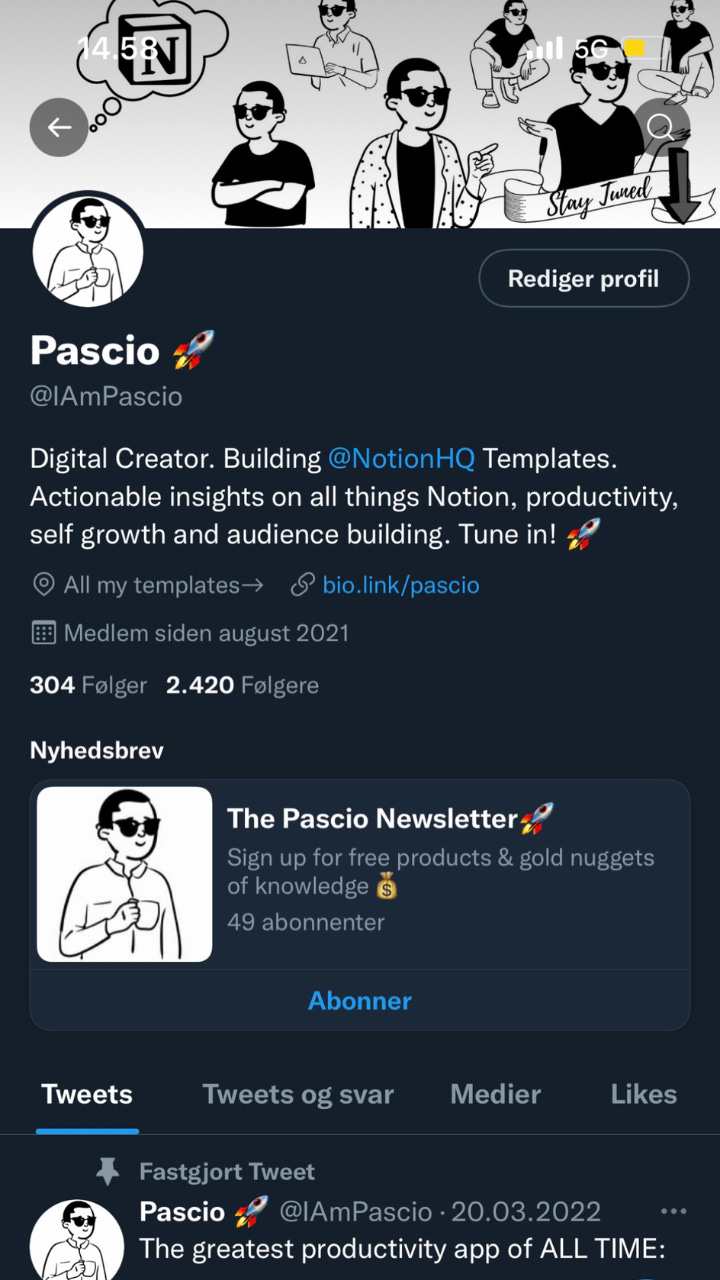
(This is the earliest screenshot I have of my profile. I wish I’d taken more pictures when I just started out. Once you finish this article and implement the 90-day Faceless Business Apprenticeship that I’ll give you later, please promise me you’ll take a screenshot of your profile Day 1, because future you is going to LOVE you for it).
The username choice of “Pascio” is particularly interesting, because as you can probably tell, it’s a derivative pseudonym of my real name, Pascal, and it became the little wall between the person I already was in real life and the person I was attempting to become online.
Behind that wall, I could make Notion templates, write posts, copy formats from people who were better than me, launch things, change direction, look stupid and learn how all of this internet money thing worked.
Eventually, the Notion templates I sold and the business that grew out of it, ended up generating me over $1 million.
And even more importantly, it gave me enough time to become the person I had been too embarrassed to present publicly at the beginning.
Four years after starting this whole persona online, back in January this year, I found myself standing (or sitting I guess, lol), at a Notion event in Dubai with over 100+ attendees, many of whom were million and billion dollar company representatives, because Notion had invited me on as a speaker
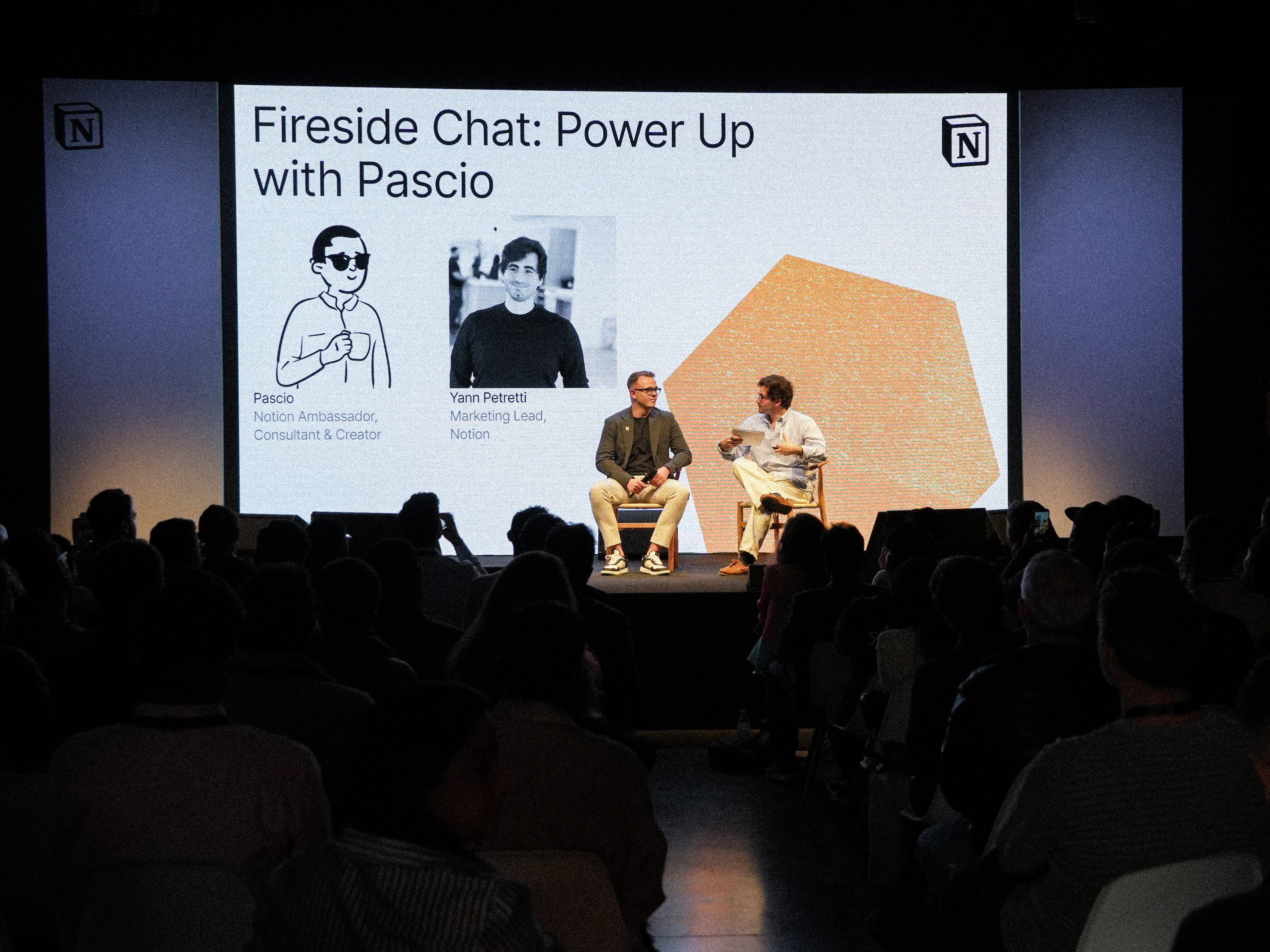
If I’m being honest, I remember finding the whole ordeal slightly absurd.
Notion, this billion dollar global unicorn brand that I used to sell templates for, knew enough about me to invite me as a speaker at their event. And more surprisingly, a large percentage of the people who showed up to the event also knew Pascio. For the first time in my life, people came up to me and asked me to take photos with them. What the f*ck. Many of whom also told me that they’d followed my journey from years back and they were so excited to finally put a face to the infamous name.
I had become strangely famous while staying anonymous at the same time.
It’s a strange contradiction, but there’s an important lesson in it. One that I wish I understood when I started out, because the internet gives you far more ways to build wealth than the phrase personal brand suggests.
You can build a brand around your name. Most people do this.
You can build one around a nickname. I did this.
You can also build one around a cartoon chicken if you wish to.
Heck, you can build one around a meme page, a documentary channel, a newsletter, a product, an illustrated character or some completely made-up word that slowly starts to mean something because you keep attaching meaningful work to it.
On the internet, face is optional. I’m living breathing proof of that.
And for a beginner who feels embarrassed, unqualified or terrified of being watched while figuring things out, this might be the best news you’ll ever receive, because yes, hiding your identity for a while can indeed be an enormous advantage.
By doing this, it gave me enough time to become the person I had been too embarrassed to present publicly at the beginning.
By the time I eventually started my actual personal brand (Creator Pascal, this newsletter you’re reading right now), and put my real face and name behind it, I had years of evidence sitting underneath me. I wasn’t scared. Quite the opposite actually. I was excited, because I had already sold products, grown huge audiences and made a good chunk of money online.
This unwavering confidence arrived after I collected the receipts.
I think this is where the modern obsession with personal brands confuses beginners.
We are constantly shown the finished version of internet success, where somebody’s face is everywhere and their personality seems inseparable from their business.
That is one route.
There is another route where the work becomes famous first.
You can become internet rich long before you become internet famous. You can even build the entire thing while remaining almost completely unknown outside the little world your business serves.
This article is for someone sitting at a job right now with a folder full of business ideas and a slightly nauseating feeling at the thought of their coworkers discovering them.
Later on, I’ll give you my 90-day faceless business apprenticeship so you can start the first version of this in one weekend and have evidence it works in the next 90 days.
Reading this may be the difference between another year of thinking about starting that internet empire you’re dreaming of and actually creating the account tonight.
First, I need you to understand one thing.
A persona gives you room to become good
When people hear “personal brand,” they tend to have this picture in their mind of doing “the perfect profile”. There is a face in the profile picture, a real name underneath it, videos on camera, friends following along, and maybe a boss quietly wondering why you are posting about business at 10:43 on a Tuesday morning.
That is a lot of social pressure to pile onto somebody who is also trying to learn a new skill (which is the thing that actually gets you paid).
Now a weak post suddenly feels personal and your failed ideas follow your name around. Even changing direction can feel overly embarrassing because you know that people saw the previous version.
Pascio absorbed that awkward beginner phase for me.
I could test an idea, watch it flop, change the hook and try again the next day, I could make a template nobody wanted, learn why, and build another one, and I could study creators who were already succeeding, borrow the parts of their approach that made sense, and slowly develop taste through repetition.
That lower amount of social pressure made me less risk averse and more willing to experiment, and the experiments then created the confidence I was missing at the beginning. Do you see the loop here?
A few posts eventually kicked off. My products started selling. People started sending messages saying how I helped them. And eventually I had enough evidence that building online started to feel… normal.
This is especially useful for people who struggle with imposter syndrome.
A beginner can create useful content while being completely honest about their level of experience. You can document what you are learning, curate good information, analyze why something worked, run experiments and publish the result.
Teaching comes later as your own experience stacks up.
Let’s break down exactly how that works.
Because I know a lot of you reading this might think:
“Who the fuck am I to talk about this?”
It’s a fair question to ask if you’re just starting out.
When I started, I was not secretly some world-class Notion expert waiting for the internet to recognize my genius. I was a student. An apprentice. Still actively learning.
Most beginners are.
And they get way ahead of themselves when they believe creating content requires standing on a digital stage and declaring themselves an authority.
“Thou must obey mine genius skill and authority, though I hath naught to prove it!”
No, seriously.
You probably should not pretend you have experience you haven’t earned.
Thankfully, useful information can come from more places than personal expertise.
A beginner can document. You can show the problem you are currently trying to solve, what you tried this week and what happened.
A beginner can also curate. There may be fifty useful pieces of information scattered across podcasts, books, obscure Reddit threads and research papers. Putting the ten best ones into one clear resource saves somebody else five hours.
A beginner can analyze. You can study someone who already has the result and break down how they got there.
A beginner can experiment. Try ten landing pages, thirty hooks, five diets, three morning routines, twenty AI tools, whatever fits your subject, then publish the result.
Eventually, you can teach. That final stage becomes much easier because the previous stages create your experience for you.
I think of it as borrowing authority from reality until you have enough of your own.
Suppose you have 300 followers and want to write about audience growth.
“How to grow to 100,000 followers” is going to feel ridiculous coming from you, well… because it is ridiculous coming from you.
But “I studied 100 accounts that grew past 10,000 followers this year. Here are the seven patterns I found” is a completely different piece of content.
Now the value comes from the work you did.
I think you see the point I’m making here.
Now, do that for long enough and you’ll see something magical start to happen.
You study 100 accounts, apply the patterns, and your account grows from 300 to 2,000. Now you can write about the experiment.
You repeat it and reach 10,000. Now you have a case study.
Someone asks you for help. You help them reach 10,000. Now you have proof outside your own account.
Three years later, a beginner discovers you and assumes you were always an expert.
They missed the apprenticeship because you performed it in public.
This is one of the most useful properties of content that I feel not enough people talk about. Publishing can become part of the process through which you earn the authority you initially lacked.
And the beautiful and most powerful piece of this equation, especially if you’re scared of what others think of you, is that a faceless account makes that apprenticeship so much easier to stomach in the first place.
There is a little less ego attached to each attempt because each piece of content is allowed to fail without feeling like you failed (in front of everyone you went to school with).
That means you’l automatically attempt more things. And more attempts give you data. More data helps you improve. And eventually, well, the results catch up with the ambition inevitably.
Mine did.
But only because somebody else showed me the path first.
I copied a faceless 19-year-old
Before Pascio became anything, I was watching another account for a few months.
Easlo.
If you were in the Notion corner of Twitter around 2021 and 2022, you probably remember this guy. A pure marketing and branding genius, if you ask me. Black and white design style, minimalist, a master Notion template builder
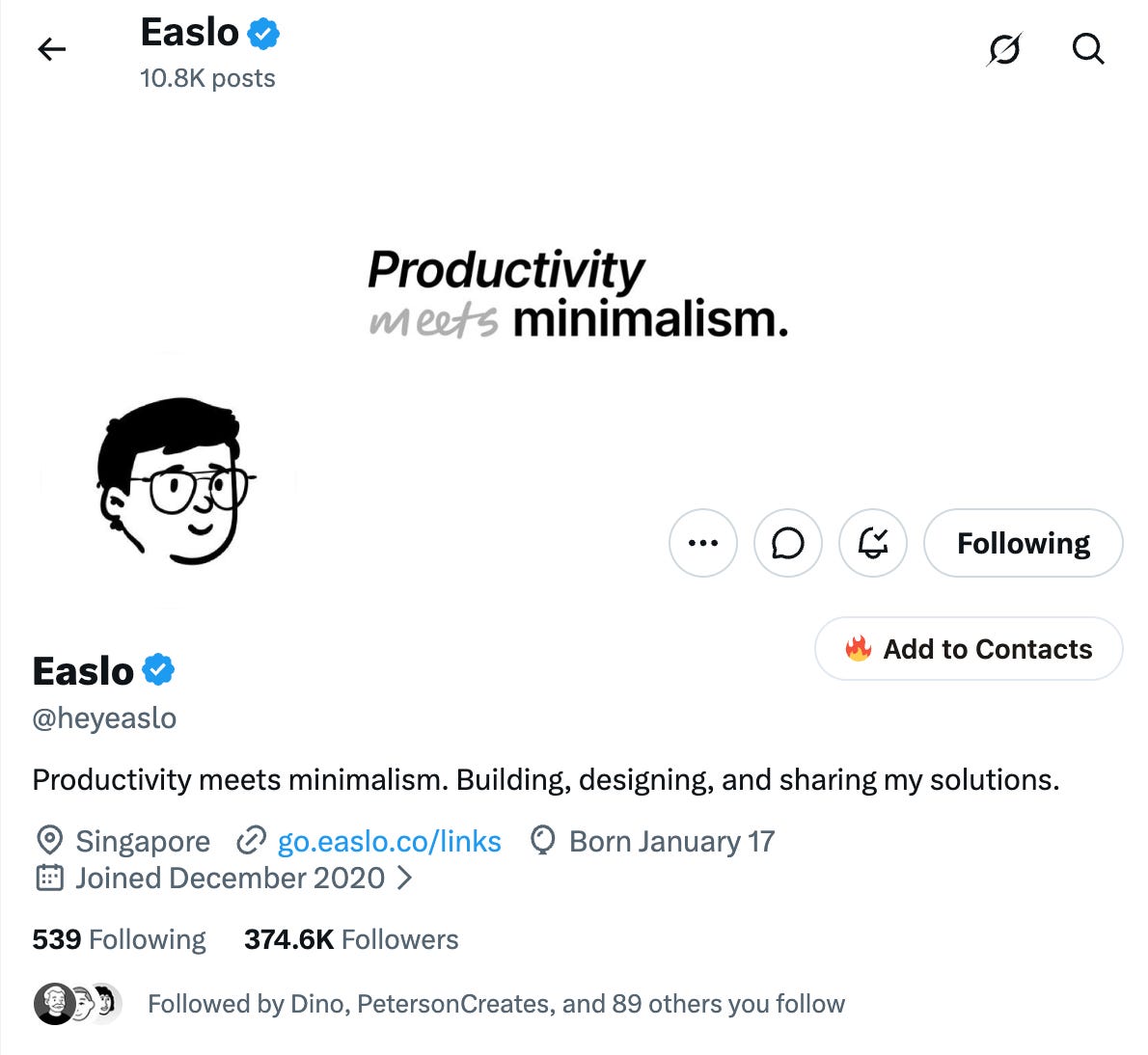
Everything he did had this simple visual language that made you recognize an Easlo post and an Easlo product before you even checked the username.
When I discovered him, his account was essentially 100% faceless.
To this day, he still is.
I was sitting there wondering if some weird little Notion account could become a serious business, and somebody else was answering the question in public.
On October 11th, 2021, I saw this post from Easlo.
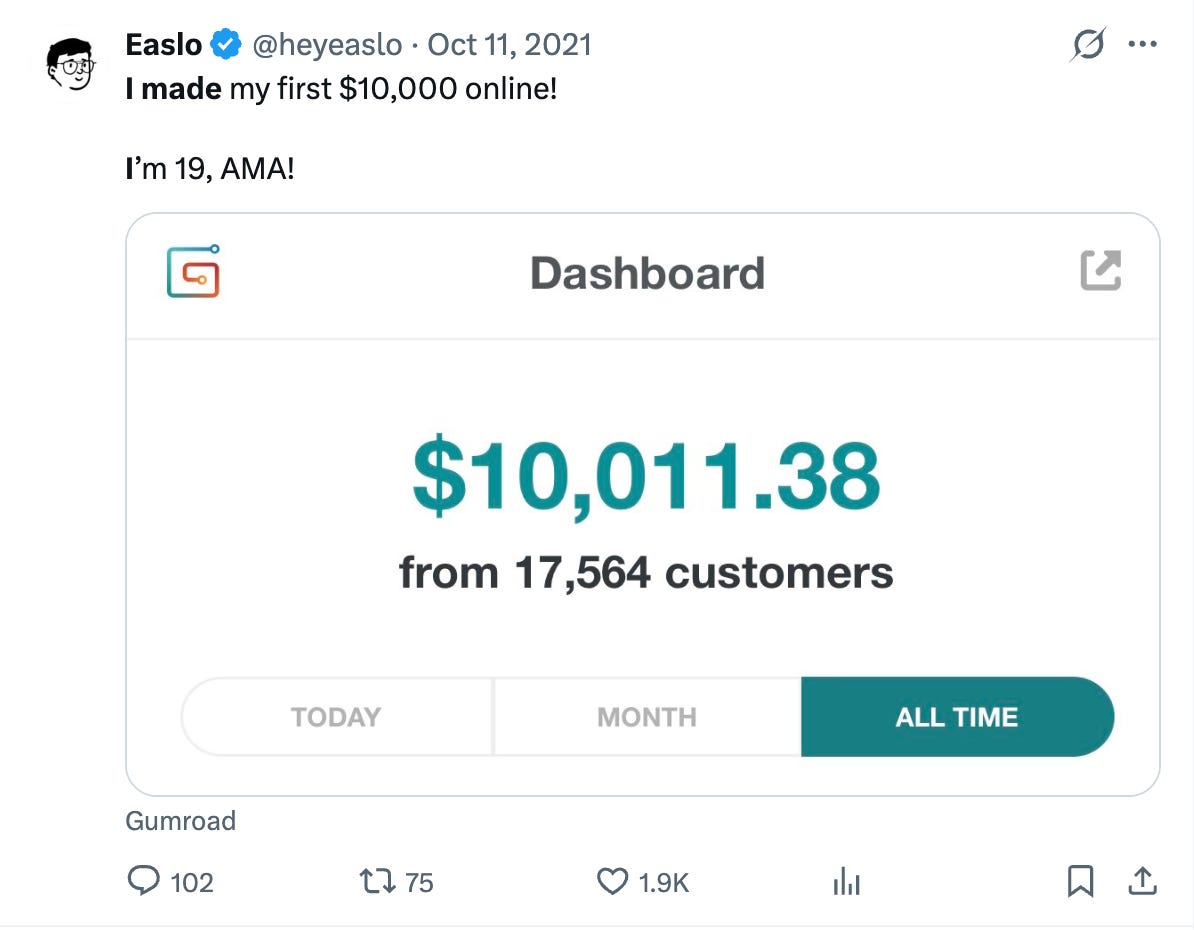
That was the day I decided to start.
I remember thinking: “If this guy could make $10,000 from a faceless cartoon character profile picture account… why can’t I?”
That was the day I decided to start.
Now before you come at me and say “WELL YOU JUST STOLE HIS IDEA AND COPIED HIM”, take a chill pill and read this article first:
You Don’t Need A Unique Idea To Get Rich
Because the truth is, you don’t. You just need to find someone a few steps ahead of where you want to be, and then model what they did.
Don’t copy them. I didn’t become “Easla” or “Oslo”. I did my own version. With my own cartoon character. And my own content and style and voice.
But I couldn’t have done all that without this guy pioneering the way.
Now, what he did was actually pretty simple, once I broke it down into an 8-step loop.
He made something useful for himself (Notion templates).
He shared it online.
People paid attention.
Their attention revealed demand.
He packaged the useful thing as a product.
The product gave him more things to talk about.
The content attracted more people.
The larger audience created more customers.
That loop is a business model in itself.
And none of those steps require the founder to be famous.
I followed the exact same process. I won’t go too much into it here, but I shared my templates on Reddit, got my first customers, shared the process on Twitter and eventually scaled it into a real business.
And along the way, my brand Pascio, slowly acquired meaning.
This is especially important to understand:
Brands acquire meaning.
At the beginning, “Pascio” meant absolutely nothing. It was a collection of weak ass tweets and probably subpar products compared to Easlo’s.
But then I studied what worked for others and made my shit better.
And eventually, people started associating my name, Pascio, with Notion templates and a guy hustling on Twitter to build a business in public, just like “Easlo” began as a nickname Jason created in 2021, derived from the word “easy”, with years of templates, content and visual consistency to give the name weight.
This is where the idea of a personal brand starts becoming unnecessarily restrictive.
A face is only one signal people can remember.
A name is another.
That means a cartoon character can work. Or a specific visual style. Or a recognizable writing voice. Or a f*cking picture of a chicken. It doesn’t matter.
Humans are perfectly capable of forming relationships with symbols. Companies have understood this for a century. Nobody needs Ronald McDonald to show them the legal name of the person who developed the Big Mac before trusting McDonald’s enough to order one.
The internet simply made it possible for one person to build those symbols.
And some people have taken that much further than a Notion account.
The green chicken that became the person
I keep bringing up the chicken for a very specific reason.
Doomberg, a Substack newsletter, is one of my favorite examples because the anonymity went all the way into the brand design.
The team behind it came from heavy industry, energy and hard sciences. They wanted to publish analysis around energy, finance and geopolitics while staying anonymous, so they needed the publication itself to become recognizable.
They chose a green cartoon chicken.
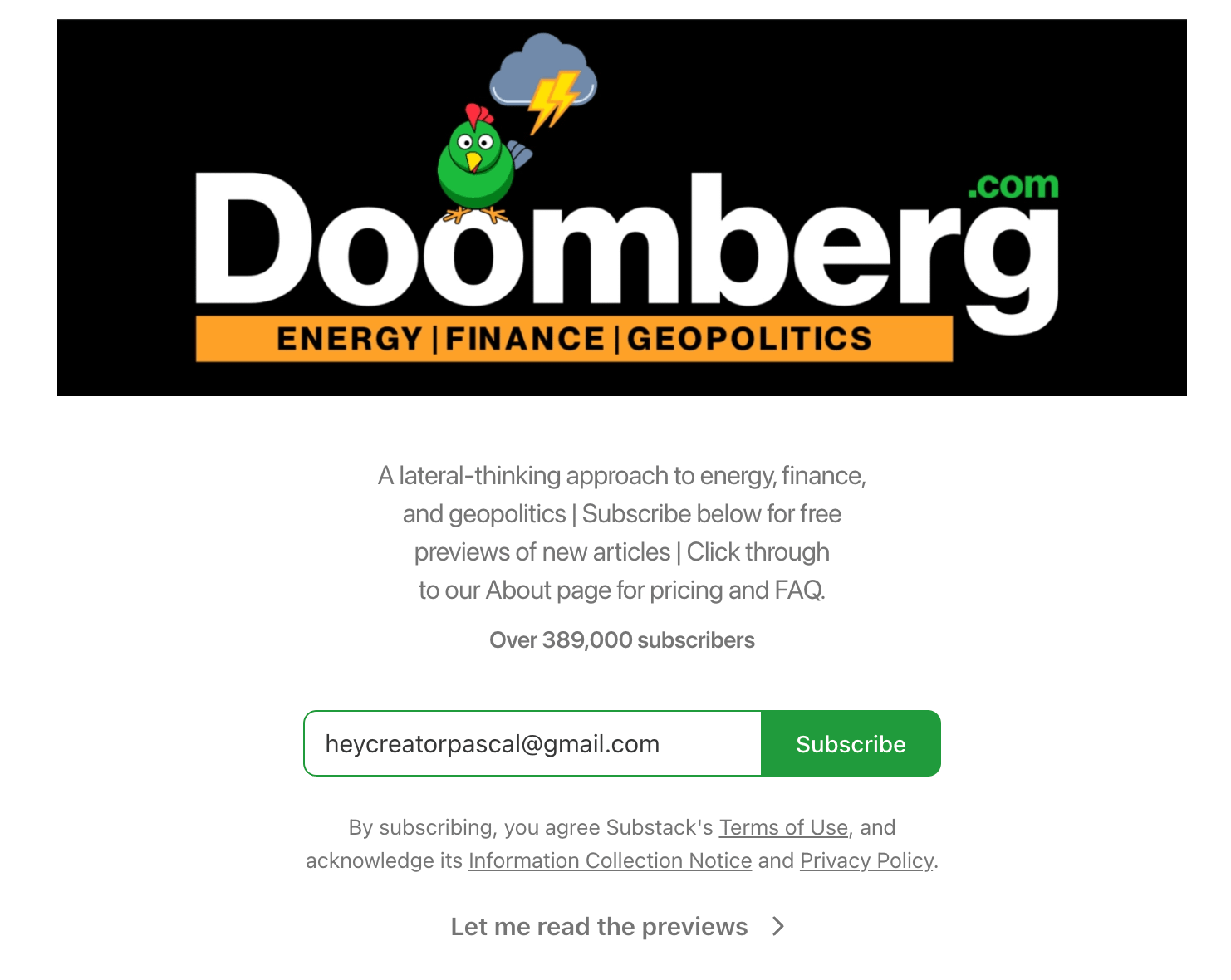
This decision was much more deliberate than it looks.
The team wanted an avatar people could recognize immediately on Twitter, which was their primary marketing channel at the time. The chicken also fit the name and their “Chicken Little Gets a Terminal” identity.
Before launching, they created a brand book and defined an ideal reader. Their first Substack article went live on May 3, 2021. One year later, they had published 105 articles, built an audience of tens of thousands of subscribers and generated millions of views.
Think about what a human face usually contributes to a creator business.
Recognition
Continuity
Personality
Trust
Doomberg built each of those around the chicken and the writing.
Recognition came from seeing the same green avatar repeatedly.
Continuity came from the publication showing up with the same voice and subject matter.
Personality came through the language, arguments and worldview.
Trust accumulated through the quality of the analysis.
Eventually Doomberg became Substack’s top-earning finance publication.
I love this example because it exposes a very specific little detail that far too often gets lost when people talk about “building your personal brand.”
People care about a creator’s identity because it helps them predict the experience.
You see MrBeast’s face on a YouTube thumbnail and you instantly know what the video will feel like. Or you see DAN KOE’s name on a Substack article and you instantly know you’re about to have your entire worldview shattered.
Or… you see the green chicken and know Doomberg has arrived.
The brain eventually learns the symbol.
It doesn’t need to be a name. Or a face. It can be something as stupid as a green chicken.
But there’s a disclaimer here though.
A faceless account in particular, cannot rely on anonymity as an excuse to be generic, because when you remove your face, there’s a vacuum. And something has to fill that.
That could be your unique taste, your distinctive writing, your specific design style, heck, even a mascot you invent.
Faceless works extremely well when the brand has a face of its own.
Even if that face is not an actual face.
Let’s go a level deeper so you can understand how to truly become internet rich (without necessarily becoming internet famous).
Your first product is attention
There’s one story I read recently that I find particularly interesting.
In March 2017, a finance employee created an anonymous Instagram account called Litquidity and started making memes about Wall Street.
Due to the nature of his job, he naturally needed to stay anonymous. It gave Hank Medina, the guy behind the profile, room to satirize an industry he still worked inside.
The account grew because the humor was unusually specific to the people living in that world. Bankers, students, investors, and finance obsessives recognized themselves in the jokes. That recognition created a concentrated audience.
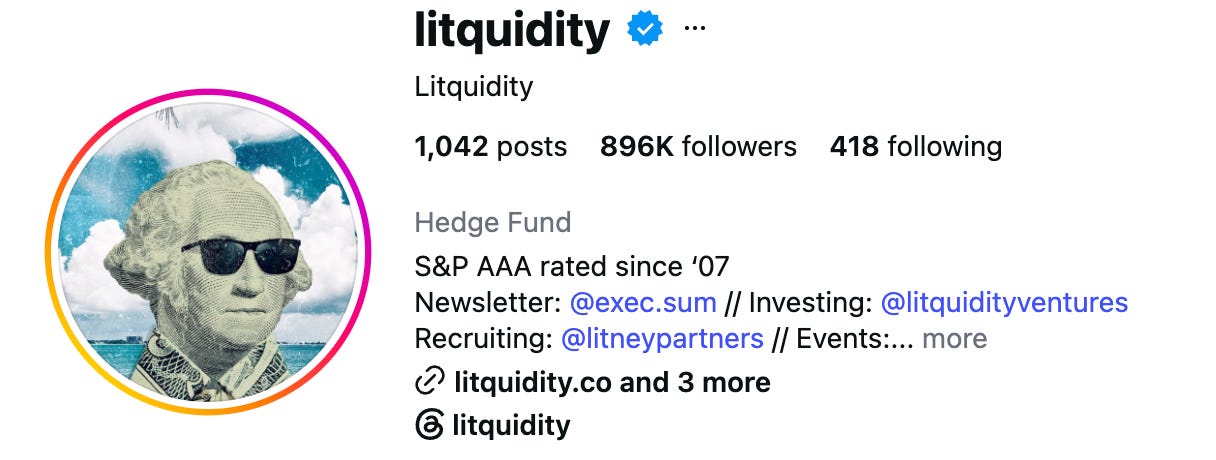
Medina eventually left Wall Street and started scaling the brand.
It expanded into newsletters, recruiting, events, startup investing, and a wider portfolio of social accounts. In his 2024 year-end letter, he wrote that he had kept his identity hidden for nearly seven years and believed the anonymity had become part of what made the brand special.
His followers would send him sensitive information, ask for advice, and propose business opportunities based on the brand and its work rather than his personal credentials or background.
By that point, the broader network he’d built reached more than 2.5 million people, and his newsletter, Exec Sum, had crossed 300,000 subscribers.
Eventually, he built Litquidity Ventures which deployed $10 million during 2024.
The business kept expanding after his giant reveal. He’d built a collective audience of 2.5m+ people, done 60-plus startup investments, and had deployed more than $30 million across the venture portfolio.
In Medinas own words, social media and community was the secret advantage.
Another one is FuckJerry.
They followed a similar path, but way earlier. The founder, Elliot Tebele began with a Tumblr page, moved to Instagram, and slowly shifted toward comedy after noticing that funny shit went viral far easier.
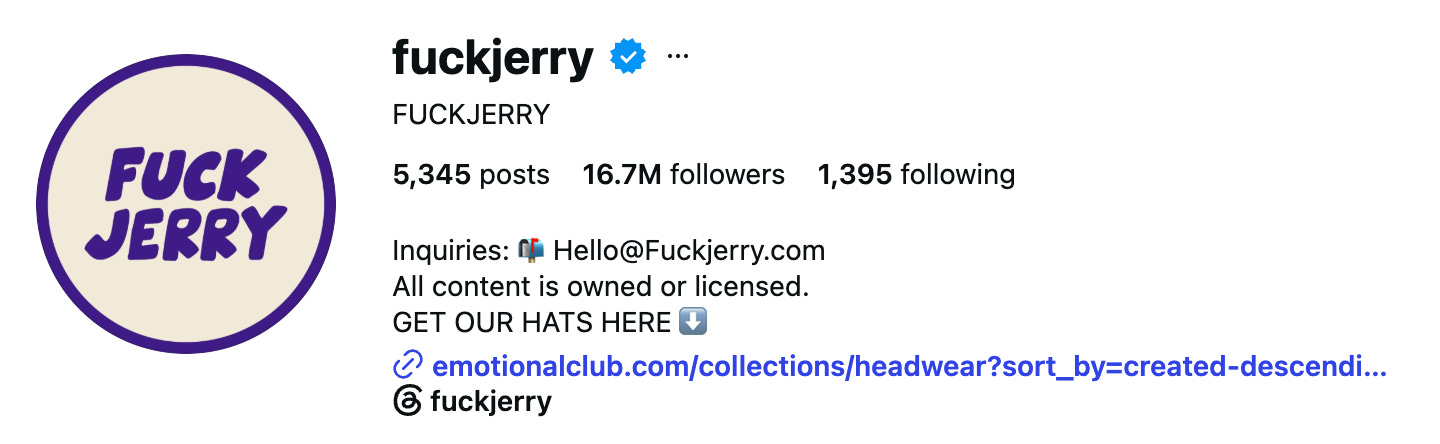
In 2014, the account had several hundred thousand followers and accepted its first sponsored post, charging Burger King $3,000 to promote… chicken fries.
Eventually, he grew more accounts and expanded into branded content, merchandise, and even a card game (What Do You Meme?) that did almost $3m in its first year.
For both these people, attention was the first asset.
This phrase sounds generic, I know. Especially because social media platforms trains us to see attention as likes, views and follower counts only.
But there are essentially two sides to attention.
One is fame and the other is distribution.
And they’re very different from one another.
Distribution means that when you create an offer, you already know how to reach people who may care about it. The same challenge that even the best product creators you know today struggle to solve.
Fame is different. It spreads your identity across a broad population.
Distribution gives you repeatable access to a relevant market. Some people are geniuses and possess both. But you don’t need to do that.
A quiet faceless business can create extraordinary wealth with the second asset alone.
And ironically, more often than not, excelling in the second one, often leads to the first one as a byproduct.
Pascio is a great example of this.
It lived inside this narrow world where people interested in Notion knew the brand while the average person had no real reason to care.
That concentration was particularly helpful because every template, post, and product I created, was created with existing context.
This is what I mean by becoming internet rich without becoming internet famous.
You can be well-known inside the small world where your customers are, without being famous to everyone.
Then the business keeps growing because the same things keep working for you. Your products can be sold many times, old content can keep bringing in new customers, your email list lets you reach people again later, and good customer results make more people trust you.
So you can build a business that reaches people all over the world, while still running it with a tiny team from your laptop and living a pretty normal private life.
The internet is unusually good at creating this arrangement. It also makes the first version of a business much simpler than the word “business” suggests.
The Stuff Underneath The Avatar
When people imagine starting a company, they tend to skip right to picturing the legal entities they need to setup, the employees they need to hire, domains they need to acquire and all the software subscriptions they need to build the product.
A small internet business begins much closer to the ground, with a small group of people who share a problem or desire.
Basically, it works like this:
Pick a group of people with a problem.
Maybe they use Notion and want better systems, templates, or ways to make money with it.Post useful stuff about that problem.
The more good content people see from you, the more they recognize you and trust that you know what you’re talking about.Give them something to buy.
Once they trust you, you sell them a product or service that helps solve the problem faster or better.
That’s the basic funnel.
But the important part is what happens after that.
You listen to what people keep asking about. Those questions tell you what they struggle with. That gives you ideas for new products and new content.
Then customers buy your product and get results. Those results become proof that your stuff works, which gives you more things to post about.
So the whole thing becomes a loop:
Content gets attention → attention brings customers → customers give you money, questions, and results → those give you ideas for better products and more content → that content brings more people in.
That’s basically what happened with Pascio.
Notion was already a big market with people spending money. I made Notion templates people wanted. Twitter gave me a place to find those people. Free templates let them try my work first. Some of them then bought the paid products.
As more people followed me, bought things, joined my email list, and talked about my products, I built up assets that stayed with me.
So after a while, I wasn’t starting from zero every time I launched something. I already had followers, customers, emails, products, proof, and people who trusted me.
Every time the machine went around once, the machine got bigger.
Basically, this means that a creator business becomes valuable when your content leaves something behind.
A post that gets 1 million views sounds great, but if nobody joins your email list, buys anything, or remembers you, most of that attention disappears.
A smaller post can be worth much more if it brings the right people into your world.
For example:
Post → email signup → product → customer → repeat customer
Now one post can keep making you money long after it was published.
That is why X in particular is such a good place to start a faceless business.
Writing a post is cheap and fast. You do not need cameras, editing, lighting, or days of production. You can have an idea in the morning, post it before lunch, and know by the evening whether people care.
That means you can test a lot of ideas quickly. And every post teaches you something.
Imagine you start an account about AI for lawyers. You post general AI news and people barely care. Then one day you post:
“Here’s how lawyers can use AI to review employment contracts.”
That post gets 5x more attention.
People start asking questions in the replies, so you answer one of those questions in another post. That post does well too.
Then a law firm messages you asking if you can set the system up for them.
Now the market is basically telling you:
“This is the problem we care about. We might even pay you to solve it.”
You did not have to sit in Notion for three months trying to guess who your perfect customer was.
You learned by publishing.
That is the bigger idea here.
Your X account becomes a place where you can:
test ideas
learn what people care about
find customers
improve your writing
discover products to sell
understand your market
Being anonymous makes this easier because you may feel less pressure when something flops.
If a post gets 200 views, whatever. Try another one.
If the wrong type of people respond, change the topic.
If 500 people visit your sales page and nobody buys, something about the offer is wrong. And then, if you keep getting the same question from customers, that right there might be your next product.
You just have to keep making small adjustments based on what actually happens.
After doing this hundreds of times, you start developing something even more useful.
Instinct.
Or in today’s AI age, also called taste.
You know which hooks are weak because you have written hundreds of them, you know which offers probably will not sell because you have launched before and you recognize valuable problems because customers keep mentioning them.
That is where confidence in your craft eventually comes from.
Beginners think they need confidence before they start. But confidence usually comes after you have done the same thing enough times to know you can handle it.
This brings us to the practical part. The examples above prove that faceless businesses can grow large. A new account still begins with an empty profile and a person who has to decide what to do on Monday morning.
So what do you actually do?
I present to you:
The 90-day faceless business apprenticeship
You can create the first version of your account this very weekend. Then you give yourself ninety days to see it through, before deciding what the business should eventually steer towards for the foreseeable future.
Most people make the first decision much harder than it needs to be. They believe they have to choose the perfect niche before posting, so they keep making it smaller and more specific.
“AI” feels too broad, so they move to “AI for lawyers.” Then they narrow it to “AI for 45-year-old independent lawyers who handle divorce cases.”
Now the account is specific, which some gurus love to tell you is the way, but it also means almost nobody can relate to it so you lose the power of mass attraction.
That and you’ll be inside a subject that bores you after two weeks.
But mass attraction presents another problem. An account about “AI” could post about software, art, jobs, coding, business, law, education, hardware, and a hundred other things. A new visitor has no idea what the account will give them.
That, and there’s a ton of “AI accounts” out there already, so competition is fierce.
I’ve found that the best starting point usually sits somewhere in the middle.
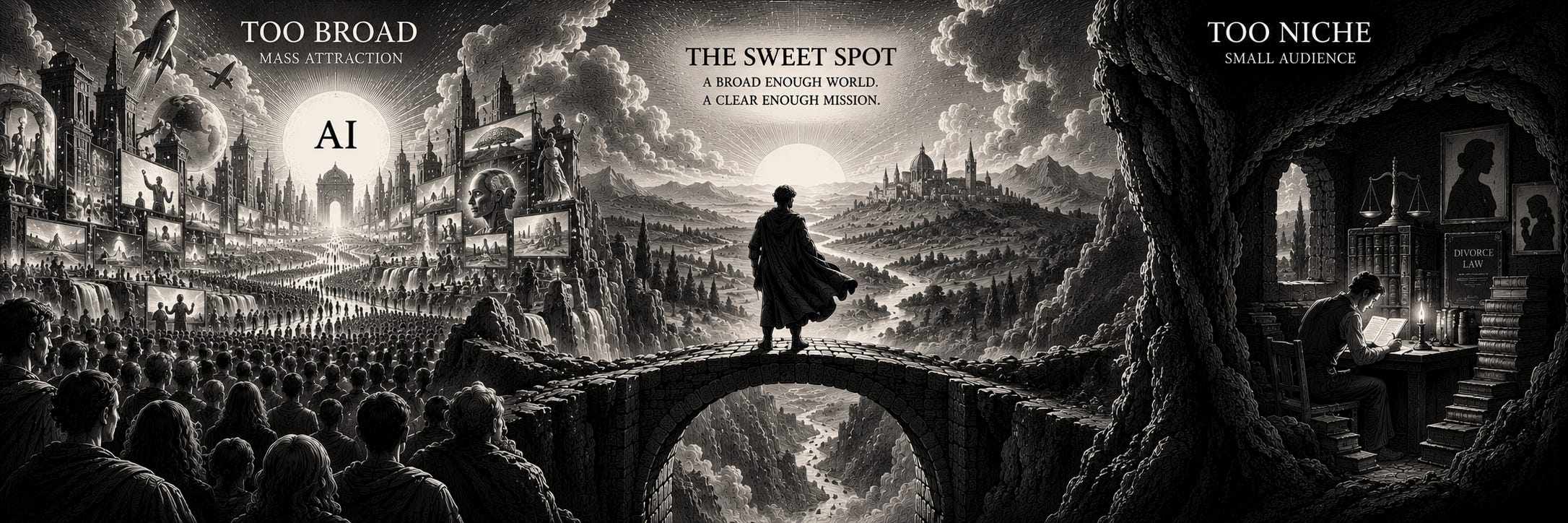
Choose a broad world that gives you room to grow, then build the account around a clear goal inside that world.
When I started Pascio, I publicly said I was going to build a $10,000-a-month business in three months.
That was the story. It was literally in my bio.
Notion was simply the world I was playing in, and templates happened to be the first product I sold within the confines of that world. So people came for the useful Notion content, but many of them stayed because they wanted to see whether I could reach the goal I’d set out in public.
It meant that every post I did helped move the story forward.
A new product launch became part of the attempt. A failed launch became part of it too. If I learned something about pricing, Twitter, Gumroad, Product Hunt, or digital products, I could share it because it helped explain what I was doing.
I know this worked, because one of my best performing formats in the beginning, one that always seemed to go semi-viral, was me posting my milestones.
“I just made my first $100 online!” would get hundreds of likes while “top 10 Notion tips” got just a handful.
The goal gave the account a plot.
A normal niche account gives people information. Great. More stuff to digest. But an account built around a real attempt at something gives them a mission to follow.
Curiosity is a stronger attraction that you’d think, and it turns out to be even more useful when you have very little authority to speak about anything at the beginning.
Start with a world and a mission
Your world should be broad enough to give you hundreds of things to talk about. Your mission should be clear enough that somebody can understand why they should follow.
A few examples you can steal from:
“I am building a $10k/m newsletter in six months and sharing every number.”
“I am using AI to launch three small apps in the next 100 days.”
“I am learning copywriting by trying to close my first ten clients.”
“I am going from zero coding experience to publishing my first paid app.”
“I am building a one-person business while working a full-time job.”
“I am trying to grow a faceless account to 100,000 followers in one year.”
The mission gives you direction without forcing you into a tiny subject.
An account about AI can become interesting when the person is using AI to build a business. An account about fitness becomes easier to follow when the person is training for a real event. An account about writing gains a story when the creator is trying to publish a book, grow a newsletter, or earn their first dollar from words.
The goal can always change later.
But your first mission exists to give the account somewhere to go.
Here’s how to do it right now.
Choose something you genuinely want to achieve. And when I say genuinely, I mean it, because you will spend months thinking about it, testing ideas, and sharing progress on it. So the goal should create enough pressure that you care whether you reach it. Ideally, you even make an emotional goal (I recommend setting yourself a Brute Force Goal if you want to really dial it in).
Once you have the mission, set up an account in one afternoon.
Pick a name and profile picture. Don’t overthink this part too much. Then write a bio that explains the attempt in one sentence. Next, create a pinned post that covers four things: where you are starting, what you are trying to achieve, why you care, and what people will learn by following.
Do not wait until you have a business plan.
This account is where you will begin finding the plan.
Days 1 to 30: become an apprentice in public
During the first month, treat yourself as a learner.
You have no reason to pretend you already know everything. Your lack of experience can actually give the account its story because the audience gets to watch you figure things out.
Spend time every day studying people who are already ahead of you. Read their posts, buy some of their products, watch their interviews, study their launches, and look at what they did when their audience was still small.
Then share what you are learning in your own words.
A beginner can create useful content in several honest ways.
You can curate by finding good information and bringing it together. You can analyze something that worked and explain why you think it worked. You can document what you are doing and what happened. You can run experiments and publish the results.
Teaching from deep experience is a thing for later.
Suppose you are trying to build an AI business. During the first month, you could test tools, break down small AI companies, share your unqiue workflows, compare business models, study successful launches, and document your own attempts to build something.
You could write stuff like:
I studied 20 AI tools doing more than $10,000 a month.
Here are the five business models that appeared most often:
Or:
I tried building a small AI tool this weekend.
Here is what took four hours, what took two days, and where I got completely stuck:
Or:
I tested five AI website builders using the same prompt.
Here is what each one produced:
These posts have incredible value because you did the work behind them so others didn’t have to. And you did it without any prior skills. Except now you’ve actually acquired the skill of curating knowledge and documenting it.
If you’d like to learn how to write more posts like this, you should consider joining my $8/m Skool community, X Academy, where I teach you the exact steps to do so.
Now, your first month should have volume. Lots of volume. I posted around six times a day when I started. You could choose a lower number, but one post every few days gives you very little practice and very little feedback on what works and what doesn’t.
And as you’re just starting out, this is probably the most helpful pieces of advice I can give you: the trick is to post so much content until you notice some pieces start to stand out with more engagement than the rest.
Those are your winners. You study those, figure out why they worked and then do more of it, while cutting out the stuff that didn’t work.
Do this for enough time and you’ll be a content creating genius in no time.
Write one longer weekly update about the mission too. Share your numbers, what changed, what worked, what failed, and what you plan to try next.
These updates create open loops.
If you tell people you are launching something next week, some will return to see what happened. If a product fails, they will want to know what you change. If you make your first sale, the people who saw you begin at zero feel involved in the progress.
If you think about it, it’s the exact same mechanic for why people are glued to Netflix watching television shows all day.
They want to see what happens next.
The first few followers you get will often come through conversations, so make sure you spend time replying under larger accounts in your world. That’s how you get people to notice you. Specifically, write replies that add an example, a useful point, a personal experience, or a different angle. Avoid AI reply tools and general “cool post bro!”-bullshit at all costs. Ten thoughtful replies each day will teach you more (and get you more followers) than writing “great post” under a hundred tweets.
Replies also let you practice in front of an existing audience.
You learn which ideas get reactions before turning them into full posts.
At the end of the first month, you should have a small body of work and a better understanding of the subject you’ve chosen.
You may still have no idea what your product will be.
That is fine.
Just understand that you are now actively in the process of building raw material.
And raw material is better than no material.
Days 31 to 60: let your account find its shape
After one month, your account will start giving you clues.
Some posts will attract far more attention than others. Certain subjects will create replies and questions. A few people may send you messages asking how you did something or where they can learn more.
Pay attention to those signals without letting one viral post control the whole account.
A post can get enormous reach because it touched a broad topic that has very little connection to what you eventually want to build. Another post might get one tenth of the views while bringing you three messages from exactly the type of person you hope to serve.
Both numbers are important here, but understand that they mean different things.
My recommendation is to go through every single thing you posted during that first month and find the patterns.
Which subjects did you enjoy writing about?
Which posts brought the right people?
Which ideas made people ask questions?
Which experiments gave you something original to say?
Which posts could you imagine expanding into ten more?
Use the answers to choose two or three main directions for the next month.
You are still allowed to explore. In fact, you should continue to do that.
You simply have better clues on which direction to explore in.
This is also where a recurring series become useful.
If you are building an AI app, you could publish a weekly build report with your progress, costs, mistakes, and user numbers. You could break down one successful AI company each week. You might test one new growth method every Friday and return with the result.
If you are trying to build a writing business for example, you could analyze one successful newsletter each week, publish your own growth numbers, and document every attempt to sell something.
A recurring series helps people remember the account because they know what kind of post may appear next. It also makes writing easier because the format already exists.
Keep the mission visible at all times too.
When I was chasing $10,000 a month, the goal gave every update context. If I made $500, people knew what that number meant. If I had a strong launch, they could see how much closer it moved me. The same sale would have felt much less interesting without the public target behind it.
Your goal gives ordinary events a place inside a larger story.
During the second month, start talking directly with the people following you. Ask what they are trying to achieve. Read their replies. Answer their questions in public when the answer could help other people too.
You can also share unfinished thoughts and ask the audience what they think. This gives you a better view of the problems they care about, and those problems will eventually point toward the product.
And most importantly, never stop learning throughout this phase.
You are still an apprentice.
The difference is that you now have enough practice to form your own views.
You may disagree with something a larger creator says, you may notice that advice everyone repeats has failed in your own experiment or you may discover a strange pattern in your numbers.
Share that sh*t.
Original ideas often begin as friction between what somebody told you and what happened when you tried it.
Days 61 to 90: let the product reveal itself
By the third month, you should have enough information to begin thinking seriously about a product.
Use the previous sixty days as your product brief.
Go through your replies, messages, notes, and strongest posts. Look for things people repeatedly ask you to explain, share, or help them with.
Sometimes the product is already sitting inside that infrastructure.
If people keep asking for the spreadsheet you use, the product may be a template.
If they ask whether you can do the work for them, start with a service offering.
If the same question keeps appearing, you may have the outline for a guide, workshop, or even a mini course.
Or, if you have built a manual process that solves the same problem again and again, it may eventually become software.
This is roughly what happened with Pascio. Templates were a natural product because I was building systems in Notion and sharing them with people who wanted similar systems.
The product fit the content because it came from the same work.
Your first product should help your new audience make progress toward the thing they already follow you for.
If people follow your attempt to build an AI app, you might sell the research database, prompts, code blocks, or process you developed along the way. If they follow your attempt to grow a newsletter, the first product could be a template, writing service, workshop, or system that helped you grow.
I recommend you keep the first version small intentionally.
You are still learning. A simple service for two clients may teach you more than spending three months building a large course. A small paid template can show whether people value the system before building it into software. And a live workshop can help you understand which parts confuse people before you hit the record button for a full length 10 hour course.
Make sure you offer the early version to the people who have followed the journey.
Tell them what you built, why you built it, who it helps, and what result it should create. Then ask a limited number of people to try it.
If people buy, work closely with the first customers. Watch how they use the product. Notice where they get stuck. Ask what they hoped would happen when they paid.
Their feedback will improve the next version and give you more useful content.
If nobody buys, that’s fine too. It’s feedback. Use it to study the responses you get. Maybe the problem is too weak, or your product is just too unclear, or heck, maybe your audience just cares about a different part of your work.
Whether the product succeeds or not, it just becomes another part of the public story.
You can share what you are building, what customers asked for, what you changed, and how the first launch went. Good or bad.
Your audience watched you attempt it.
Now they can watch the attempt turn into a business, or stay tuned for the second attempt. Both are wins.
What you should have after ninety days
Your follower count could be 500, 5,000, or much higher. Growth moves at different speeds depending on the subject, your skill, your volume, and whether any posts break out.
The result you need to study is what you learned along the way.
Ideally, you come out of the 90 day sprint with a clear public mission (whether achieved or not), a library of posts, and a better idea of which parts of the subject hold your attention. Yo'u’ll most likely have a better feeling for which ideas attract people, what questions keep coming back, and which type of content fits you best.
Best case scenario, you may also have your first product, first customer, or first meaningful amount of revenue.
But most importantly, even if the latter doesn’t happen, you now have a real account with a story behind it and months of training running it along with useful data and acquired taste to keep scaling.
You have moved beyond sitting alone in a dark room trying to guess what your niche should be. You have spent ninety days learning in public, studying people ahead of you, testing ideas, and listening to the people who chose to follow.
That gives you a much stronger place to build from.
The account began with a goal. The goal gave you something to write about while you were still learning. The learning attracted people interested in the same journey, and their questions helped show you what you could eventually sell.
This is the apprenticeship I want you to undertake.
Start an account before the business idea is clear. Give people a reason to care about your attempt. Learn fast enough that your posts become useful, then notice which parts of the story people keep pulling on.
By the time you build the product, you will have more than an idea.
You will have an audience telling you what it wants.
You can introduce yourself later
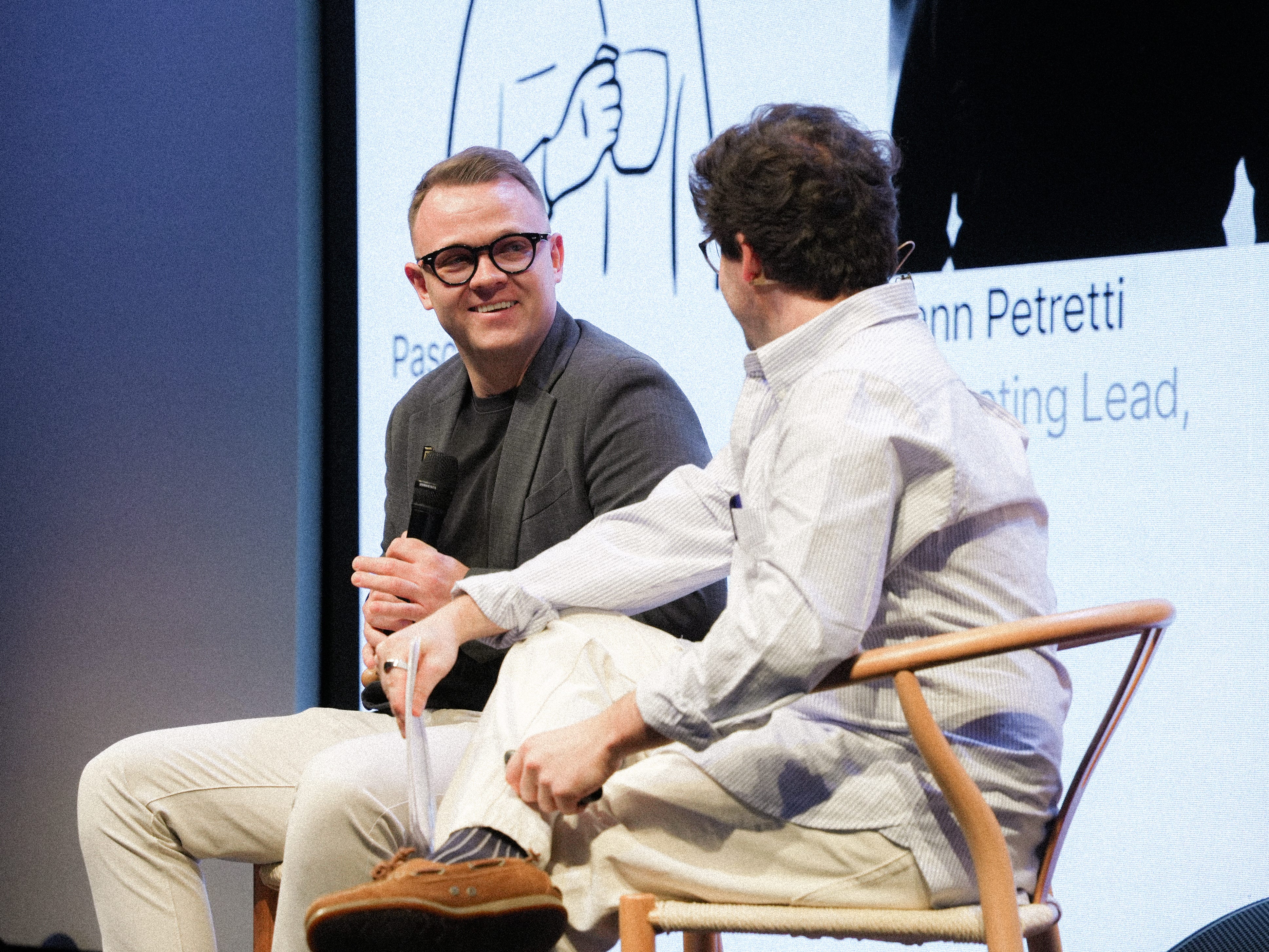
I created the Pascio persona because I wanted somewhere to hide. Years of useful work made the hiding place visible enough that Notion invited the person behind it onto a stage in front of hundreds of strangers.
The irony still cracks me up.
By the time I said yes to speaking at that event, showing my face had become much easier because my results carried the weight and removed my uncertainty.
I could talk about products and audiences from direct experience, and putting my full name behind that work felt natural because the identity now had a history behind it.
I’m forever grateful to Pascio, this little fictional internet character, and more importantly to myself for building it, because Pascio was what carried me across the uncomfortable gap between wanting to become someone and having enough evidence to believe I was.
If fear of being seen has kept you trapped in your ideas folder, I encourage you to create a random username today with some random ass profile picture. Whatever. Just choose something. The n build a research library, publish your first one hundred posts, and I promise you that you will find a problem that somebody is going to pay you to solve.
Just let the work accumulate before asking your identity to carry all of it.
Eventually you will become comfortable enough to put your name on everything, and even so, you might still just prefer the privacy and end up keeping the brand between yourself and the audience. Both paths are entirely valid and both paths will lead to a serious business equally.
Just remember that you’ll need ideas worth returning for, a recognizable source, a relevant audience, and an offer that solves something useful once you get there.
So there ya’ have it.
My way-too-lengthy-8,000-word-essay on how to become internet rich without necessarily becoming internet famous.
This is my blueprint and it’s what I tell every beginner who asks me to “put them on”.
In fact, I did actually write this so I no longer have to answer those people when I can just send them the URL and tell them to go read this instead.
90 days.
It’s is all it takes.
You got this.
- Pascio
P.S.
If you’d like to go faster, I help people do this exact thing on X.
I work with them on their positioning, research, ideas, content, and overall system that turns what they know into an account people want to follow.
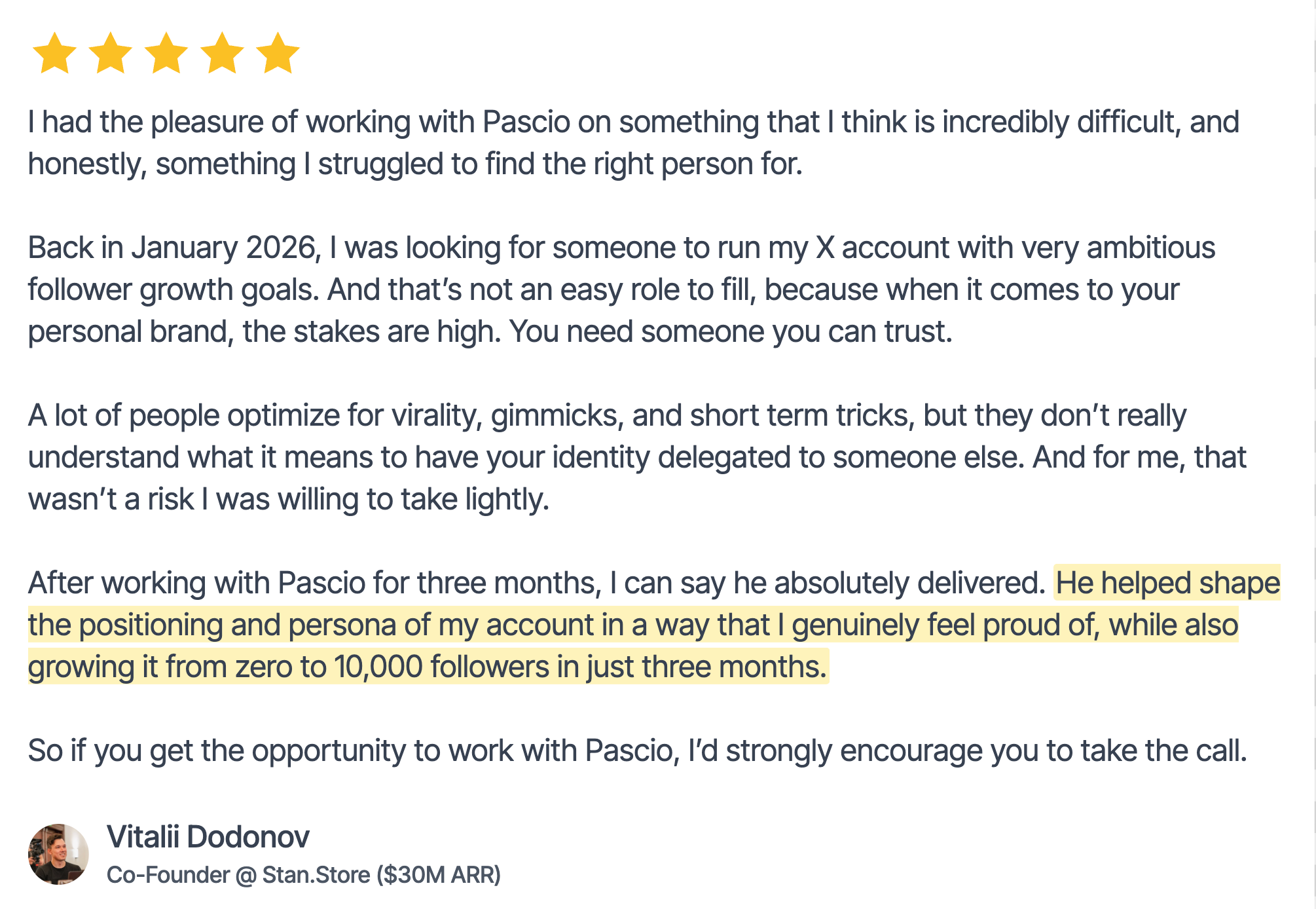
I’ve done it for faceless accounts, pseudonyms, brand accounts and personal brands (like Vitalii Dodonov, the founder of Stan Store, who I grew from 0 to 20k followers in just 6 months). He specifically said this about working with me:
Want my help building your X account? I have two ways I can help you:
If you want me to personally ghostwrite for you (not cheap), just DM me the word “SUBSTACK” on Twitter so I know you came from this article, and I’ll share more details about how it all works.
If you prefer to do it yourself, you should join my $8/m Skool community X Academy instead, where I give you every resource you need to DYI your way to the top of the Twitter food chain. You can check that out here.
Thanks for reading Internet Leverage!
Internet Leverage is my weekly newsletter exploring the new rules of work, money and life, and what becomes possible when one person suddenly has access to distribution, software, AI, capital and a global market.
I write about one-person businesses, attention as an asset, AI as leverage, internet-native wealth, ambition, culture and philosophy. More broadly, I’m interested in what happens as technology rewires how we work, think and live, and how you can use those shifts to get ahead.
Some essays are practical field guides.
Others are me following an idea until I understand it better.
For you, it’s an edge.
A way to learn the new rules while everyone else is still playing by the old ones, spot opportunities earlier, make better bets, and compound the advantage across your work, money and life.
Subscribe below for free to join 33,000+ subscribers receiving weekly posts.
(or click here to read a few editions first)
You can also find me on:
Twitter│YouTube│Instagram